Showing posts with label Stonecoast MFA. Show all posts

Tuesday, May 26, 2020

Guest Blogger Christin Geall on Insta-prose: Developing an Audience Through Images

Christin Geall is a Canadian writer, designer, photographer, and author of Cultivated: Elements of Floral Style (Princeton Architectural Press, 2020). Her writing and floral work focuses on the intersections of nature, culture, and horticulture, and she teaches internationally. Trained in horticulture at the Royal Botanic Gardens, Kew, she completed a BA in Environmental Studies & Anthropology and a MFA in Writing (at the Stonecoast Program in Maine, which is where we met), and has been a writing professor and gardening columnist for Gardenista. Architectural Digest called her book “delightfully vibrant” and the Seattle Times recently quipped "Geall might just be the M.F.K. Fisher (American grande dame of food writing) of flowers." 

Please welcome Christin Geall

Flash nonfiction? The segmented memoir? The prose poem? When I was in graduate school studying creative nonfiction, I mastered none of these forms. Despite a background as a lifestyle columnist and editor, I couldn’t write both poetically and short. But I yearned to, so I studied stylists like Abigail Thomas, MFK Fisher, and Annie Dillard.

To get one thing straight right away: I’m a terrible storyteller. And not a great consumer of aural nonfiction stories, either. At dinner parties I’d sooner listen to someone tell a tale as watch them pick their teeth. I like ideas, conversation, and a bit of banter, yes, but I didn’t think myself ironic enough, clever enough, or frankly even online enough, for Twitter. And Facebook, well, I found it either too political or too congenial for decent exchange of thought, much less story.

Enter the image as a writing prompt. A subject for discussion, and suddenly all my storytelling and audience problems were solved. Looking back on how I accumulated 97,000 Instagram followers, and the success of my recent book Cultivated: The Elements of Floral Style (Princeton Architectural Press, 2020), I see now how my training in the micro-essay changed my career as well as my relationship to nonfiction.

I had evolved into a personal essayist, memoirist, and an academic by the time I joined Instagram in 2015, yet I had always struggled to write the longform pieces that my career required. I did possess a deep knowledge and love for plants, so I had thirty years of passion to write about, in addition to a fascination with the ideas and language of the fine arts. Creativity is universal—what I’d learned in grad school about the process of writing, workshopping and critique, I applied to my work with flowers – and then to how I’d tell short stories around them.

On Instagram, where a post is driven by one image, you are limited to 2,200 characters, or roughly about 350 words. Given I’m more sprinter than marathoner, the platform fit. Those 350-ish words, I found, are ample space for a concept to be explained, an idea explored, or even a bit of narration.

As I lobbed ideas to a hash-tagged audience and reflected on their comments, I found my thinking (and opinions) refined. As I encountered friction, or clarification, I entered into conversation. I made friends, of course, learned, networked, and steadily over the past few years, became a sought-after voice in my field.
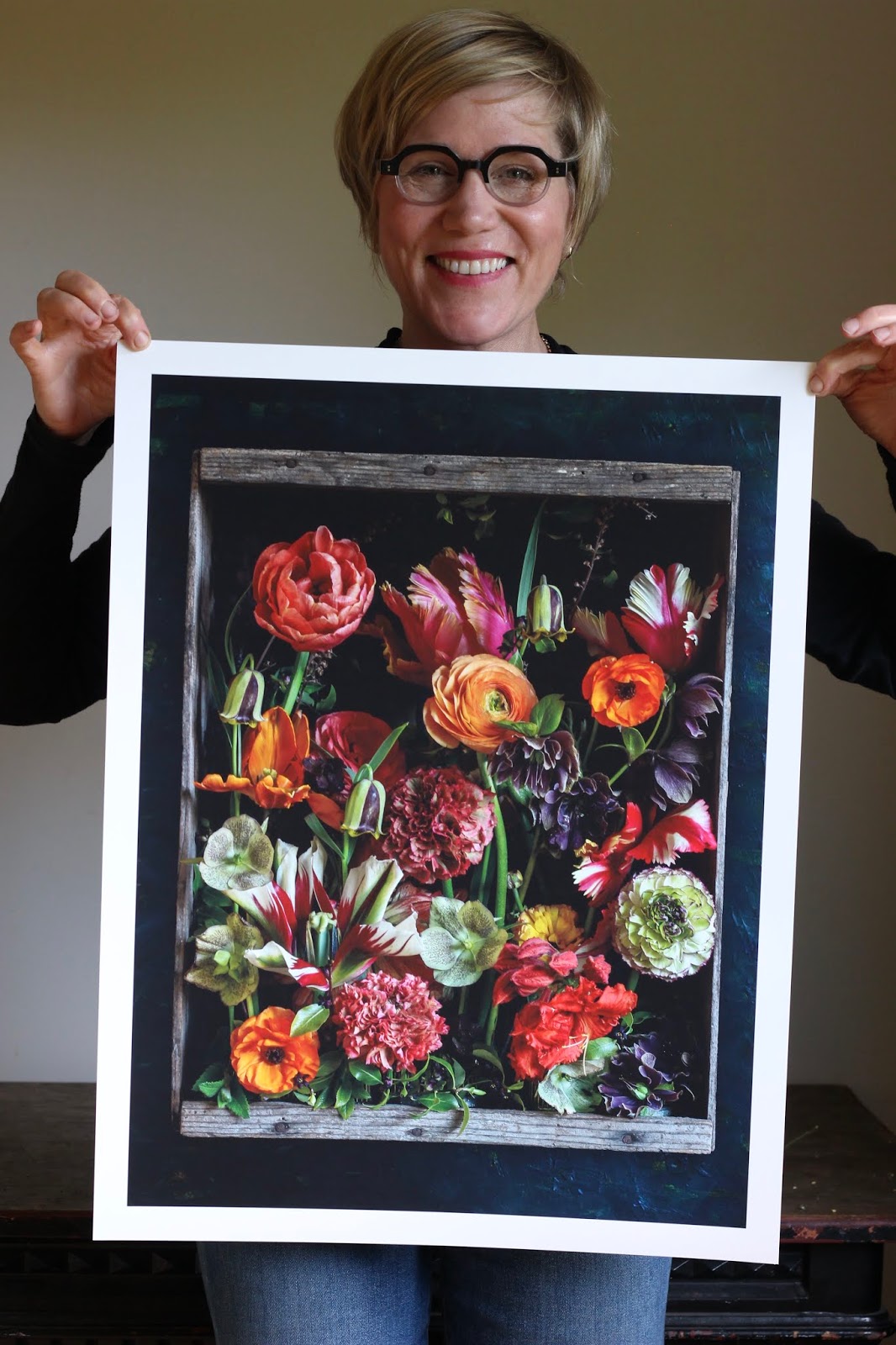
 When the speaking invitations arrived, I was ready; I built my talks with multiple short “stories” about flowers and the ways they connect us with nature, painting, history, ourselves—just as a good essayist, memoirist, or columnist might do on the page.

By the time the book deal happened—a book combining my photographs with short essays on style, creativity, and everything from Baroque music to wabi sabi to the psychology of colour—I not only had an audience who wanted to learn more, but also 20,000 of the 40,000 words needed for the book.

Photography was not something I’d ever truly wanted to learn, but now that I have, I’m grateful for its silence and the way it pulls me creatively. At first, I had to stretch to create images I thought worthy of an Instagram post, let alone a book, but as I learned to use a camera I found the art itself became another subject for inquiry, which is of course, always a good thing for an essayist. Long or short form.

Note from Lisa: You can connect with Christin at her website, and on Instagram, Facebook, or Twitter. You can find her book, Cultivated, at major online retailers, or order from Indiebound or through your local independent bookstore.


Thursday, July 6, 2017

Summer Reading List with a Twist

I mentioned last week that part of my summer reading list is included in a round-up. What I didn't explain was that I constructed my list with one criteria in mind: books written by someone with whom I once shared a classroom during the MFA program I completed nine years ago, or a writer who followed or preceded me in that same program.

I bought those authors' books when they were released, to support my fellow alumni in their writing lives, and because I genuinely want to read them. Inevitably, the To-Be-Read pile grows worryingly high, the books I thought I'd read soon get buried, and before you know it, I'm hopelessly behind. I suppose this is forever the case for anyone who loves to read and who has to read for work...the want-to-read list must always wait until the have-to-read list is completed, and we hope there's some time and mental energy left over.

The summer reading list idea took hold when I learned there's to be a reunion later this month for the Stonecoast Program MFA (University of Southern Maine). Although I'm still not sure I can get to it, the idea alone was enough to kick off my list. That, and this spring I was leading a memoir writing group at my local library just when the staff was preparing the children's section for the big summer reading extravaganza. 

I remembered back to all the summer reading I did as a child, how much I longed for those long unstructured summer days when I could sit under a tree in the backyard with a pile of library books a foot high. Mom would periodically bring me a glass of lemonade, and ask, "Still reading?" Yup.

Here's the Stonecoast part of my summer list (I'm also sneaking in a few others). Perhaps you'd like to add a few to your TBR pile!

Those I've completed (you can read my reviews over on my Goodreads page):

The Butcher's Daughter by Florence Grende, a memoir of growing up as the child and grandchild of Holocaust survivors. 

A Kinship of Clover by Ellen Meeropol, an unusual novel about plants, ecoterrorism, family, and being different. 

In the Context of Love by Linda K. Sienkiewicz, a novel of family secrets and the always challenging path of love. (Linda's Q/A on that book's path to publication is here.)

Next up: 

Writing Hard Stories by Melanie Brooks, in which she interviews writers who tackled difficult memoirs (also- find Melanie's guest post here).

The Language of Men by Anthony D'Aries, a memoir of father-son love, travel, and discovery. 

Pigs Can't Swim by Helen Peppe, a memoir on growing up the youngest of nine in a hardscrabble Maine woods family. 

Love & Fury by Richard Hoffman (an MFA mentor of mine), a memoir of the extremes of male family relationships.

I just know that ten minutes after I post this, I'll find a couple more Stonecoast student or faculty books in my teetering pile. And I'll move them over to the summer list. And maybe I'll get lucky and get them all read before that other pile/list insists on my attention: the books that I must read before my students are required to in September.

Meanwhile, I'm pouring myself some lemonade and heading outside.


What are you reading this summer?

Wednesday, February 1, 2017

Guest Blogger Melanie Brooks on: Writing Your Story, and Crying if you Want (or Need) To

Besides social media connections, and having graduated from the same MFA program, Melanie Brooks and I share a love of reading memoirs that must have cost their authors an emotional toll—those she covers in her forthcoming book, Writing Hard Stories: Celebrated Memoirists Who Shaped Art From Trauma. [We're giving away a copy, too!]

Melanie works as a freelance writer and teaches at Northeastern University and Merrimack College in Massachusetts, and at Nashua Community College in New Hampshire, where she lives with her husband, two children and yellow Lab. Her work has appeared in the Washington Post, Bustle, The Manifest-Station, Hippocampus, Huffington Post, Modern Loss, Solstice Literary Magazine, Recollectors, Stonecoast Review and Word Riot. Melanie's also working on an almost-completed memoir that explores the lasting impact of living with the ten-year secret of her father’s HIV disease before his death in 1995.

Please welcome Melanie Brooks.

The questions were simple: “What are you writing about and what form is it taking?” So, why was I finding it harder and harder to breathe as the seminar leader meandered her way toward me? As she solicited responses from the other students in the crowded room, why was there a sudden tightness in my chest? It wasn’t as if I didn’t know the answers.

I’d started my MFA at the University of Southern Maine’s Stonecoast Creative Writing Program with a clear purpose—space and time to finally write into a complex family story I’d carried for over twenty years, a story I recognized was big enough to be a book. But when the leader’s kind gaze finally fell on me, the words caught in my throat. I mumbled something about writing about my dead dad, then a strangled sob hijacked anything else I might say, and a deluge of tears broke through my reserve. I was sitting at the wall-end of a cramped row, with no possibility of discreet escape. For the remainder of the ninety-minute seminar, I struggled to stop my nose from dripping without the benefit of a tissue, and I bit my lip until I tasted blood, to muffle the hiccupping sobs that fought to surface.

Nothing in the introductory materials the program coordinators sent out in the months leading up to that first MFA residency had readied me for this horrifying public moment of absolute composure meltdown. No neon labels were affixed to the pages of the orientation handbook broadcasting: WARNING: Writing about vulnerable material can leave you feeling rawly vulnerable. Be prepared to cry. A lot. At inconvenient times.

So when the inconvenient crying first erupted during that seminar, I thought something was wrong with me. And when it happened again while my workshop group discussed my manuscript, I felt the need to make excuses to put everyone else at ease. “I cry all the time,” I said, even though I don’t. “Just call me The Crier from here on out,” I joked, sidelining my emotions.

The truth was that, during the residency, and in the following months when I sat in front of my computer, mired in the very real anguish of trying to shape my painful memories into words, I felt alone. So alone, I almost quit.

I needed to find someone to tell me what I was feeling was okay. Normal. Expected, even. If someone could tell me those things, then maybe I could marshal up enough courage to keep going.

In what began as a very personal (and totally selfish) quest, I went looking for that someone to guide me back to my laptop, someone to tell me those things I needed to hear about my pain and loneliness and fear. I wrote to authors I admired—those whose memoirs did not shy away from any of the tough stuff— and told them how much I was struggling. I asked them if I could sit down with them and talk about the psychological journeys they had to go on to write their books. 

What I found when I reached out was more than someone. I found eighteen someones. Eighteen acclaimed writers—including Andre Dubus III, Mark Doty, Edwidge Danticat, Abigail Thomas, and Richard Blanco— who all responded to my query and welcomed the opportunity to answer my questions and offer some hard-earned wisdom. Writers who’d been as terrified as I was when they began their memoirs. Who’d written into their own hard stories and made it through. Eighteen writers who’d all experienced, at some point during their processes, the inconvenient crying.

The intimate stories these brilliant and generous memoirists told me about their own struggles to find words for painful and traumatic experiences, their misgivings along the way, their moments of wanting to quit, and their ultimate relief that they did not quit, all encouraged me to keep writing and gave me the steadying I needed.

Instead of keeping these conversations to myself, I wrote Writing Hard Stories: Celebrated Memoirists Who Shaped Art From Trauma (forthcoming from Beacon Press on February 7). Each chapter is an in-depth narrative profile of my discussion with one of these authors. I share the circumstances of our meetings – from walking dogs with Mark Doty in the Hamptons; lunch with Marianne Leone and her husband, Oscar winner Chris Cooper at their home on Massachusetts’ South Shore; sipping a cup of tea while sprawled across Kate Bornstein’s bed in her New York City apartment - and the amazing insights I gain.

Since my questions are less about craft and more about survival, I tap into some areas of these authors’ processes that they’ve never shared before. I reflect on how each of these exchanges moved me away from the place where my memories were burying me and toward a completed memoir. I was motivated to turn these experiences into Writing Hard Stories by a realization that others facing the daunting journey to write into their long-carried stories, writers who also felt isolated by their particular circumstances, needed those stories and that steadying, too.

Maybe if I’d had the gift of these conversations sooner, before I started my MFA even, I might not have been so thrown by the emotions that surfaced when writing about my experiences, and when, more often than not, doing so felt like reliving those traumatic experiences. On that day of the streaming tears and hiccupping sobs, when all I wanted to do was hightail it out of that seminar room, I might, instead, have been able to turn to the person sitting next to me, shrug my shoulders, and simply say, “You know, this is what they told me would probably happen.”  

Note from Lisa: Melanie would like to send one blog reader a signed copy of Writing Hard Stories. Simply ask her a question here in the comments (and she'll stop by and answer), and you'll be entered. (U.S. postal address is required.) Post your comment by Sunday, Feb. 12.

You can connect with Melanie via Facebook, Twitter, and her website.


Thursday, July 21, 2016

The Circle of the MFA: What I Learned 10 Years Ago, and What I'm Passing On (I hope)

Every January and July, I anticipate the photos and congratulatory notes for the newest graduates of the MFA program I myself completed in 2008. The two years I spent attending residencies at Stonecoast (at the University of Southern Maine) were pivotal for me as a writer, and in many ways, as a human being.

Almost coinciding with the news about this summer's graduates, I found myself talking about what I learned at Stonecoast and how that influences my work today as an instructor and thesis advisor (in the Bay Path University online MFA program in creative nonfiction). The occasion was an interview for the Bay Path Director's Blog.

Here's a bit of my response to a question about what I most want to tell students: 

"... I want to advise every student to savor every moment, to dive in deep to every opportunity the program puts in their path, because any MFA in any form is always over too soon..."

You can read the rest of the interview here.

Tuesday, May 17, 2016

MFA Graduation Reading: Eight Years Later, Standing in Very Different Shoes

Some (not all) faculty, and all graduating students, Bay Path MFA 2016
Early this month, the seven writers who make up the first graduating class of the Bay Path University MFA program in which I teach, gathered on campus in Longmeadow, Massachusetts for a reading and celebration. 

When I got the email two months earlier, inviting faculty, it took me less than a minute to reply yes. What's a three hour drive compared to an in-real-life event of that importance? Yes. Yes. And, yes!

For an all-online MFA program, still in its toddlerhood, having those newly minted MFA students—as well as a handful of other students whose programs are still in progress—plus seven faculty members (who could make the trip), the program director, tech and program support staff, dean, and college president, all in the same room (the university's library, of course), was wildly wonderful. 
For me, the day brought memories of completing my own MFA eight years ago. Standing in different shoes this time—watching and listening to writers whose MFA journey I helped mentor—was an especially fulfilling and humbling experience. It helped me understand better why my own MFA graduating class's mentors were once shedding tears.
As I listened to the students read, I kept thinking what a privilege it is to have witnessed, and helped nurture, their transformation from excited new MFA students whose work held so much promise, to far more skilled, more confident, more interesting writers, who are delivering on that promise many times over.
It was my lucky good fortune to introduce two of the student readers. As I delivered the introductions, I was far more nervous than I ever am reading my own work in public. The occasion felt weighty, as if I had been entrusted with a job of great import, and would have only one chance to do it right. It was also very clear to me that it was not at all about me. 
realized that hardly anything equates to the feeling of telling a roomful of eagerly waiting people just how lucky they are—because they are about to hear something special, created and so carefully polished, by someone they care about.
While I was writing those brief introductions, I found myself constantly in mind of something Richard Hoffman, a faculty member of the Stonecoast MFA program, once said to me, on the eve of my own graduation: that it was time for me to cease being his student and be welcomed into the literary world as his colleague.
I have new colleagues now. Lucky me.
Onward….

Friday, April 17, 2015

Friday Fridge Clean-Out: Links for Writers -- April 17, 2015 Edition

> My Bay Path MFA teaching colleague Susan Ito describes an unforgettable experience (on the heels of AWP), that involves: one of her early books, a high school class in Minnesota, an invitation, saying yes, teenage exuberance, adoption stories, drama, connection, and the powerful ways that writing and story bring people together. Read it; I promise it will make you think differently about why we write.

> The Guardian's take on the AWP Conference, or as they call it, "the Comic Con of MFAs". I especially enjoyed seeing my MFA alma mater in the spotlight: "Some MFA graduates who have gone on to teach see a larger social value in their work. Justin Tussing, the director of the low-residency Stonecoast MFA program at the University of Southern Maine, said the MFA’s popularity is a valuable counterweight to a pragmatic culture that values technology over art. “Like we need another app,” he joked."

> Just a few more AWP Conference related links: Carolyn Forche on why poetry still matters (as if we doubted it!);

> You'll find more links to AWP coverage around the web, in my post from earlier this week.

> Ah, the cranky tough love of an editor who cares enough to be disliked (which means loved), and who pushes her authors to write revise manuscripts that become bestsellers. I love her, and I love the final two paragraphs, too.

> A short and spot-on post by Lee Martin details "The Essay Within the Essay." Or: why we so often don't write what we thought we were going to write, and why that's often wonderful.

> For National Poetry Month, Drew Myron is giving away poetry books at her blog. While there, check out her Fast Five interviews with writers.
>
> Finally, here's a slide show that would, individually or as a whole, make a great writing prompt: "50 Surprising Photos From the Past that Show How Different Life Used to Be".

Have a great weekend!

Image: Flickr/Creative Commons - Jinxmcc

Thursday, August 28, 2014

Beware of what you wish for. (And what you don't.) -- My Teaching Writing Update.

For the past seven years, I've tried to keep this blog filled with tips, advice, and resources that will help writers. For the past few months I've relied heavily on some generous guest post contributors and interview subjects (as well as link round-ups) to do the job. My own contributions dwindled because I was extra-busy. Thanks, readers, for supporting the guest bloggers, and sticking around! At first my busy-ness was all about writing, teaching, and editing in fairly equal portions. But lately, that shifted. I hope you'll indulge me a bit while I explain. Then, the plan is to get back to a more regular posting schedule in September. - Lisa

During my MFA program, I frequently thought (and sometimes said), oh, I'll never teach.
Ahem. 

Toward the end of those two years, a mentor who knew me well predicted, I think you are going to teach. It's clear you want to help other writers.

"Nah," I said. 

Three months later, a local library hired me to teach an adult memoir class and another in freelancing. Within six months, I was teaching creative nonfiction online via small private classes I'd developed. Within 15 months, I was teaching in the continuing education writing program at Rutgers University, and two years after that, I was asked to teach memoir and personal essay writing for a lovely, multiple-location regional organization, The Writers Circle.

In between, I created the *I Should Be Writing!* Boot Camp for writers in any genre (it's now on-demand solo course). Along the way, I developed a monthly coaching option, which brings so many wonderful writers my way.

Now, I'm setting out on new teaching adventures. And, I've been thinking of Barbara Hurd, who like all terrific mentors, sometimes say what their students don't necessarily want to hear. I've also come to understand the power of the MFA community one develops, too.

When Suzanne Strempek Shea, a faculty member from the Stonecoast MFA program I completed, called me about 20 months ago to gauge my interest in joining the faculty of a new all-online, all-nonfiction MFA program in the planning stages for Bay Path College (now Bay Path University), I didn't hesitate. It sounded perfect. 

I said yes, then tried to put it in the back of my mind, tried to temper my excitement. After all, it was nearly two years away, and needed all kinds of approvals and certifications before it could (would?) launch.  

A few days ago—after a summer of syllabus revision, training in the online course management system, and wonderful conference calls with the director and other faculty—I welcomed some 20 students into the two classes I'm teaching in that vibrant new MFA program.

Once the students began checking in, I realized that I was right where I wanted to be.

But there's more to the teaching story.

In April of this year, the Rutgers program was shut down; sad, but I'd had a good run there.

I live about one mile from Montclair State University. I've used the library there, attended literary events there. I've signed my kids up for programs there, our family has seen plays and concerts and sporting events on campus. And two years ago, I applied for a teaching job there. I didn't get it.

What I did get – about a month ago – was a call from the writing program director: Was I interested in teaching one section of an undergraduate elective creative nonfiction writing class? 

My plate seemed full already. But then, isn't it always? 

I was a kid who always loved school, longed for the smell of fresh pencils and the feel of new notebook pages. As an undergraduate college student, I jammed my schedule with as many different kinds of writing and literature classes as I could. I remember the feeling of being in those classrooms. I love September and the idea of a new semester. (And I'll be they one day unwittingly contribute to my Stuff My Writing Students Say series!)

So next week, I'll be in that classroom at MSU. I'll be online with my Bay Path students every day. I'll be writing. I'll be sending out the memoir. I'll be editing, and prepping for the fall session at The Writers Circle, and helping to get out the fall issue of Compose Journal.

It's a lot.

It's a little bit of everything I ever and never wished for, and clearly need.

Wish me luck.

Images: Flickr/Creative Commons - Old time teachers desk, Todd Petrie; Scrabble tiles, Denise Krebs; Notebooks, Kristen Nador

Wednesday, March 5, 2014

A Circle of Writing Mentors and Students and More

I love a circle. 

During my time in the Stonecoast MFA program, I was lucky to meet Meredith Hall, whose essays I had read in Creative Nonfiction. She gave a rousing guest lecture that stirred up strong feelings for many of us, about thinking bigger, about being generous with our stories, and bringing everything to the page, not holding back.  

Mostly what I remember is this advice:  Be audacious in what you go after -- and go after a lot. Age doesn't matter! Apply for grants! Seek residencies! Enter contests! Be bold! Why not you?

I went home, bought her memoir, Without A Map, read it in one afternoon. We exchanged friendly emails. I reread her book again slowly, and realized she'd grown up in the same New Hampshire town as my husband's cousin. A few quick emails confirmed that they were once good friends, and Meredith also remembered my sister-in-law, a frequent New Hampshire visitor during their childhoods. I was able to put them all back in touch, and that felt wonderful. 

It would be enough if the circle ended there.  But there's more.

After hearing Meredith at Stonecoast, I began submitting my work more often, and entered my first contest with an essay about visiting my father in the hospital in Las Vegas. It placed second in the Charles Simic Graduate Student Writing Contest, and with the honor came a bit of cash and publication in Barnstorm, the journal edited by the MFA program at University of New Hampshire.

Though energies and enthusiasm sometimes flag, I've kept entering, submitting, applying, and often while doing so, I think of Meredith. I interviewed her for my research thesis, and for an anthology of craft and publishing advice. 

The circle widens.

After I began teaching and coaching writers, I got an email from someone I would get to know as a lovely writer and delightful person. I remember Alyssa Martino's first email because at the moment it arrived, I was waiting for another flight in the Las Vegas airport, where I'd been visiting my ill mother. I was glad for a distraction from my sadness.

Alyssa signed up for an online classes, then to continue working on essays and memoir pieces, and finally to shape and polish her portfolio to accompany applications to MFA programs.

Where does she land but at University of New Hampshire, and in whose class does she find herself? Meredith Hall's. I've had such fun hearing from Alyssa periodically, about how much she's learned from Meredith, and the deep satisfaction she's experiencing developing her writing craft. Tell Meredith hello! I've often written back. Meredith says hi! she's replied.

When I send a newsletter about something I've accomplished, a reply invariably arrives from Meredith:  thinking of you...congratulations...delighted and not surprised...such lovely news. When I look back at craft notes taken during the MFA, she's there too.

Now, Alyssa is working toward graduation, building her own teaching skills, and working on the editorial staff of...Barnstorm. One of her responsibilities is to interview writers for a section called The Writer's Hot Seat. A few months ago, she asked to interview me. 


I'm tempted to say the circle now feels complete.  

But I know better.

Wednesday, January 22, 2014

Poetry for Prose Writers -- Get Your Regular Dose


Until about 8 years ago, contemporary poetry seemed alien to me; in some vague way, I used to think either I was too unimaginative to understand it, or those who wrote it were uninterested in having anyone who is not also a modern poet comprehend its meaning.

Then I enrolled in an MFA program and that was the end of that. Even those in the creative nonfiction track like me were rubbing up against poets all the time. Eventually, I sat in on more than the polite number of poetry seminars. I discovered poetry that relies on the narrative line, prose poems, and – biggest head-thumping moment of all – that not only might I like to write some, but that a poem may be the best exercise of all for a prose writer. This came clear to me in a workshop my final week, led by a poet, with an even mix of nonfiction writers and poets around the table.

In the last five years, I've developed the habit of purposefully reading several new poems each week (I try for one each day but don't always manage it). Some stumble into my path, which is easy enough to understand: I now have many poet friends, whose work is regularly getting posted, published, praised, and passed around. I watch for new work by poets whose material I was first exposed to in the MFA program, and later via my expanding circle of (all kinds of) writing colleagues, and try to catch up on their older works too.

Like several mentors and workshop leaders I've studied under, when I began teaching and leading workshops, I adopted the ritual of beginning each session by reading a poem aloud. I ask those gathered (usually all prose writers) for a bit of forbearance, and to first simply listen as I read. Then, I pass around copies and ask someone else to read it aloud again. Sometimes we're lucky to have someone in the room who also writes poetry, and knows far more than I about the art of reading poetry aloud.

Then we talk about it – just for a few minutes. Whatever comes to mind. The language, word choices, images. Rhythm, intent, what's purposely left out. The lyricism, the music. How does it make you feel?

I'm not suggesting to the writers at the table that they write poetry, or mandating that they read more than this one poem each week. Aside from learning to appreciate another form of written art, mostly I do it because the writers who've gathered have typically just arrived from the busyness of their non-writing lives -- jobs, families, chores, traffic, noise, ice or heat or bad news on the car radio -- and I want to create a transition moment, a specific line where we cross from that over-stimulated, fast-spinning world into the land of words, language, art on the page.

I can tell that some folks only tolerate this 3-4 minute interlude; they want to get on to the real business at hand. That's okay. Because once in a while, something else happens, something terrific. Like the other night, in a Memoir & Personal Essay class, when we read Gretchen Marquette's poem,"Ode to a Man in Dress Clothes" (originally published in the Paris Review, though I discovered it republished in Harper's) which has an uncanny resemblance to creative nonfiction. 

After we'd read it twice and talked briefly about the images, the writer's possible invocation of memory; about tone, and how the second half of the poem differs dramatically from the first half in form, pace, and rhythm, one of the woman at the table smiled and reported: Wow. I used to think I didn't like poetry at all. I used to think it was so dense and odd. But I now I like it.

That is all.

Photo: torbakhopper/Flickr Creative Commons

Monday, November 11, 2013

Guest Blogger Ruth Foley on: Poem Series That Take You Hostage, and Three Possible Escape Routes

I didn't know any poets before pursuing my MFA degree, but at Stonecoast, I quickly got to know many. It was through poets – individuals I liked and listened to, talking about their craft – that I learned to appreciate poetry; so much so that I now begin every nonfiction class I teach with a poem. Ruth Foley was at Stonecoast while I was there, but I really got to "know" Ruth after the MFA, connecting on social media, through mutual writing friends, and alumni updates. (I think I developed a little crush on her with her series of posts about weight loss at her blog Five Things,) Ruth is managing editor at Cider Press Review, a member of the writing faculty at Wheaton College (Massachusetts), and teaches workshops at The Barred Owl Retreat. Her poems appear in many places, including Rattle, River Styx, The Bellingham Review, Sweet, and Bluestem, and her new chapbook, Dear Turquoise, is available from Dancing Girl Press.


Please welcome Ruth Foley.    


I have never intentionally begun work on a series of linked poems, but three times, they have begun work on me.  Each time, I found the experience to be a little like possession—I stare off into space a lot, have trouble getting my other work done, and babble endlessly without making much sense.

As a poet, I'm used to brief possessions, a poem taking me over until it's finished with me, but when it becomes clear that I'm working on not a single poem but a series, I've learned to go along for the ride. A friend told me recently that he's begun to apply a rule he learned in aikido: it is best not to try to stop a powerful force. If you're lucky, you might be able to direct it, but if you try to get in its way, you're in for a flattening.

An individual poem is, in some ways, easy to handle. It's almost always small enough for me to keep in my head, for one thing, which means I can walk away from it once I have a workable draft. I'll go make dinner, walk the dogs, go for a run, take a shower—almost any activity will suffice—all the while turning the possibilities over in my mind. I'll make a mental list of rhyming words; I'll spend some time trying to figure out the right texture of an object I'm describing, the qualities of a specific tone I'm looking to capture, or looking up variations of color names; I'll test out rhythms and line breaks; I'll work out the details of a metaphor. Any aspect of a single poem is available to me at this point, largely because the form is compact, easily contained.

A series, however, isn't so compliant. The poems in a series are likely to take on multiple angles. Some of them might be free-verse, while others are in a received or nonce form. They can use different perspectives and speakers, different language, different tones. Though related in theme, their specific topics often vary. Writing a series is an opportunity to explore a topic in depth, and because of that, there's often no time at all between my finishing a draft of one poem and beginning work on a brand new one. Sometimes, I finish a draft and believe—rightly or wrongly—that I've made it through the generative stage of the series-writing process. Sometimes, I finish a draft knowing there are three more poems lined up behind it, and maybe more behind those.

When a series takes me hostage, often I can do nothing else. I spend all of my free time—and some time that isn't technically free—mulling ideas, thinking about the last poem or the next, wondering when it will be finished with me. I know that eventually I'll have to sort through what I've written, discard the redundant poems in favor of ones that handle their particular aspect of the topic more successfully, and revise the promising poems, but when the series is in control, there's no point in worrying about any of those tasks.

Thus, my advice for living with the creative stage of a series: just go with it.

As with individual poems, when a series is finished with me, I know it. When this happens, I often find myself taking a brief break from poetry, sometimes from literary endeavor altogether—I'll read a crime novel, maybe, or watch some terrible television. Eventually, I start to wonder, What exactly am I going to do with all these poems I just wrote?

While one of poetry's sad realities is its limited market, that is also one of its advantages, as poets can choose between submitting a series of poems individually or together to traditional print literary journals, to online journals and poetry websites, and as part of a longer collection; and we also sometimes have the option of self-publishing, be it online or in chapbook form (though publishing a full-length collection through a vanity press still carries a stigma, and often rightly so). This means that any of my series could appear as individual pieces in journals, as chapbooks, or as part of a larger collection.

For me, the right method of publication for each series I have written so far has been different. The first is a set of what I came to call "the infidelity poems"—they felt personal and real despite being fictional. While they might have made a good chapbook, they also risked becoming overwhelming when read as a whole. For that reason, I decided to send them out individually, where most of them eventually found homes in journals.

The second is a series of poems inspired by the Universal monster movies of the 1930s and '40s. I became obsessed for a time with the archetypes—the mad scientist, the specific visions of some of the monsters, the villagers—developed in those films, and with the actors who helped create them. This is, in some ways, the most complicated of my series, because it's most at risk for misinterpretation. They're not monster poems or Halloween poems, but poems about what it means to be human; and for two years I was unable to decide what to do with them. Some ended up in journals, but because so many of them seem to belong surrounded by others in the series, I eventually decided to put them together myself into a chapbook called Creature Feature, a process I'm undertaking right now.

The final series is difficult for other reasons. Styled as a series of letters written to my cousin Turquoise after it became clear she would not win her battle with liver cancer, these poems are deeply personal. While I've included a small handful of them in the chapbook  Dear Turquoise (from Dancing Girl Press), it felt to me that collecting them as a whole might become overwhelming for a reader. In fact, I was reluctant to send them to journals, even in small batches. There is no gap in these poems between the "speaker" and the poet—both are very clearly me, the poet, and the subject is very clearly my grief. It was important to me that I find the perfect way of putting these poems out into the world—I kept saying that I needed to do right by these poems, because publishing them in the wrong way would cheapen them.

A few months ago, I realized that the poems could serve as thematic anchors for a longer collection, so although they could certainly fill a dedicated section of my book-length manuscript, I've chosen to weave them throughout as guideposts along a larger route through the book. There, they feel settled, at home, honored. Will a wise editor agree with me? That remains to be seen.

I'm comfortable with my decisions about the three series that so far have come to me. Working with a series—both the writing and the publishing options—can teach us more about who we are as poets and the place we want our work to take readers.

 Note from Lisa:  You can watch a video of Ruth reading one of the Dear Turquoise poems (and 2 others) at the Extract(s) site. Two of her monster movie poems ("Dear Dr. Griffin" and "Dear Ardath Bey") are up at Forge.


Tuesday, September 17, 2013

Guest Blogger Karen Pullen on Writers Police Academy. Or, Wake Up and Smell the C4

One of the best parts about Stonecoast, the MFA program I completed, was the opportunity to meet writers in other genres – fiction and poetry of course, but Stonecoast offers one of the nation's only MFA concentrations in popular fiction. Which is how a nonfiction writer like me got friendly with Karen Pullen.  Karen's debut mystery novel, Cold Feet (published by Five Star Cengage), was released in hardback in January, and in ebook format last month. She's published stories in Ellery Queen Mystery Magazine, Spinetingler, Every Day Fiction and anthologies, and teaches occasional workshops at Central Carolina Community College.

Please welcome Karen Pullen.

The typical mystery writer is a voracious reader who made her literary way from Nancy Drew to Agatha Christie and now devours Ruth Rendell, PD James, and Sue Grafton. She’s probably an introvert, a homebody, a mild  soul. She owns cats. She’s a mom, a teacher, a social worker, a librarian.  (No kidding, this description fits me and 90 percent of the mystery writers I know.)

Her only contact with law enforcement and the criminal justice system has been jury duty and her vote for a sheriff. She’s never been in a jail, known anyone who went to prison, compared fingerprints, interpreted blood spatter, or interviewed a “person of interest.”

But her readers expect and deserve authenticity, whether she’s writing about the FBI, evidence analysis, or the local police department.

So what’s a writer to do? How can she write convincingly of courtroom procedure, forensics, prison, DNA evidence, drug smuggling, human trafficking – with virtually no personal experience?

Lee Lofland – retired police investigator, author and consultant -- to the rescue. Four years ago, he organized an intensive three-day, hands-on conference held at Guilford Technical Community College in Jamestown NC, the site of a law enforcement, EMS, and firefighter training facility --  Writers’ Police Academy

WPA is a blast.  I’ve been twice. In 2012, I managed to squeeze in less than half the offerings, so of course I had to go back, along with about 160 other mystery writers.

 This year’s WPA began with a vehicle extrication. We watched a heavy rescue team take apart a car by prying open doors, removing its roof and lifting the dashboard. Impressive teamwork.

Heavy Rescue 1, car 0.


Kathy Bradley, a writer, smart lady, and juvenile court DA from Georgia, told us how to get it right in the courtroom – the layout, who’s there, order of business.  So many details! For example, I didn’t know that a defendant can waive a jury trial and ask for a bench trial before a judge, when the crime is so heinous that a jury won’t be sympathetic. And the most important characters in the courtroom? Lawyers, with witnesses a close second.

The chief of police of Thibodaux, Louisiana, Scott Silverii, gave an overview of law enforcement organizations and their structure, and told us fascinating anecdotes about small-town policing after Hurricanes Katrina and Rita devastated his area. Did you know that it’s better to be stopped for speeding by a sheriff’s deputy than a policeman? Since sheriffs are elected, they court good will. Scott also shared the three most common calls to a police department: false alarms, animal complaints, and keys locked in car. Not very glamorous!

Dr. Dan Krane, a professor and DNA expert, described the science of  DNA analysis and also the potential for misuse of DNA as evidence.  DNA can be planted, old, transferred innocently, contaminated in the lab, or misinterpreted.  I’m definitely going to watch his videos. DNA misuse would make a twisty mystery plot.

When we gathered outside on Saturday morning, someone observed an abandoned backpack and summoned a bomb squad.  Reno, a beautiful German Shepard and trained bomb-sniffer alerted to explosives in the backpack.  A remote-controlled robot picked it up and carried it farther away, then a technician in a bomb suit laid a charge next to it, to be detonated remotely. Phew! We were safe, and wiser in the ways of bomb squads.

Even the bloggers among us found too much to describe – ride-alongs, firearms training simulation, underwater evidence recovery, traffic stops, new recruit training, building search, microbiology, fire scene investigation, arrest techniques, street prostitution, cold case investigation. The professionals were there to teach us what they do, the departments to bring their equipment to demonstrate, the scientists to explain the research. 

Equally important to me were the personalities. Generally speaking, I find cops to be reserved, wary. They are not selling anything, they are not trying to entertain. At WPA, they seemed to uphold my impressions -- protective of each other, skilled, committed, and preferring never to fire their weapon. They answered any number of questions honestly, fully, and carefully. They seemed to appreciate the opportunity to explain so writers could get our facts right.

My chapter of Sisters in Crime, a national organization for women mystery writers,
subsidizes members’ cost for WPA, making it very affordable for seven members of our chapter (only $100 each for the three days).


WPA sells out very quickly, and no wonder. It’s the coolest, most exciting (writing, or maybe any!) conference I’ve ever attended.

Note:  Karen will stop by the blog several times over the next few days, to answer any questions you'd like to ask her, about the WPA, mystery writing, her book, etc. Just leave it in comments.