Showing posts with label Canadian writers. Show all posts

Tuesday, May 26, 2020

Guest Blogger Christin Geall on Insta-prose: Developing an Audience Through Images

Christin Geall is a Canadian writer, designer, photographer, and author of Cultivated: Elements of Floral Style (Princeton Architectural Press, 2020). Her writing and floral work focuses on the intersections of nature, culture, and horticulture, and she teaches internationally. Trained in horticulture at the Royal Botanic Gardens, Kew, she completed a BA in Environmental Studies & Anthropology and a MFA in Writing (at the Stonecoast Program in Maine, which is where we met), and has been a writing professor and gardening columnist for Gardenista. Architectural Digest called her book “delightfully vibrant” and the Seattle Times recently quipped "Geall might just be the M.F.K. Fisher (American grande dame of food writing) of flowers." 

Please welcome Christin Geall

Flash nonfiction? The segmented memoir? The prose poem? When I was in graduate school studying creative nonfiction, I mastered none of these forms. Despite a background as a lifestyle columnist and editor, I couldn’t write both poetically and short. But I yearned to, so I studied stylists like Abigail Thomas, MFK Fisher, and Annie Dillard.

To get one thing straight right away: I’m a terrible storyteller. And not a great consumer of aural nonfiction stories, either. At dinner parties I’d sooner listen to someone tell a tale as watch them pick their teeth. I like ideas, conversation, and a bit of banter, yes, but I didn’t think myself ironic enough, clever enough, or frankly even online enough, for Twitter. And Facebook, well, I found it either too political or too congenial for decent exchange of thought, much less story.

Enter the image as a writing prompt. A subject for discussion, and suddenly all my storytelling and audience problems were solved. Looking back on how I accumulated 97,000 Instagram followers, and the success of my recent book Cultivated: The Elements of Floral Style (Princeton Architectural Press, 2020), I see now how my training in the micro-essay changed my career as well as my relationship to nonfiction.

I had evolved into a personal essayist, memoirist, and an academic by the time I joined Instagram in 2015, yet I had always struggled to write the longform pieces that my career required. I did possess a deep knowledge and love for plants, so I had thirty years of passion to write about, in addition to a fascination with the ideas and language of the fine arts. Creativity is universal—what I’d learned in grad school about the process of writing, workshopping and critique, I applied to my work with flowers – and then to how I’d tell short stories around them.

On Instagram, where a post is driven by one image, you are limited to 2,200 characters, or roughly about 350 words. Given I’m more sprinter than marathoner, the platform fit. Those 350-ish words, I found, are ample space for a concept to be explained, an idea explored, or even a bit of narration.

As I lobbed ideas to a hash-tagged audience and reflected on their comments, I found my thinking (and opinions) refined. As I encountered friction, or clarification, I entered into conversation. I made friends, of course, learned, networked, and steadily over the past few years, became a sought-after voice in my field.
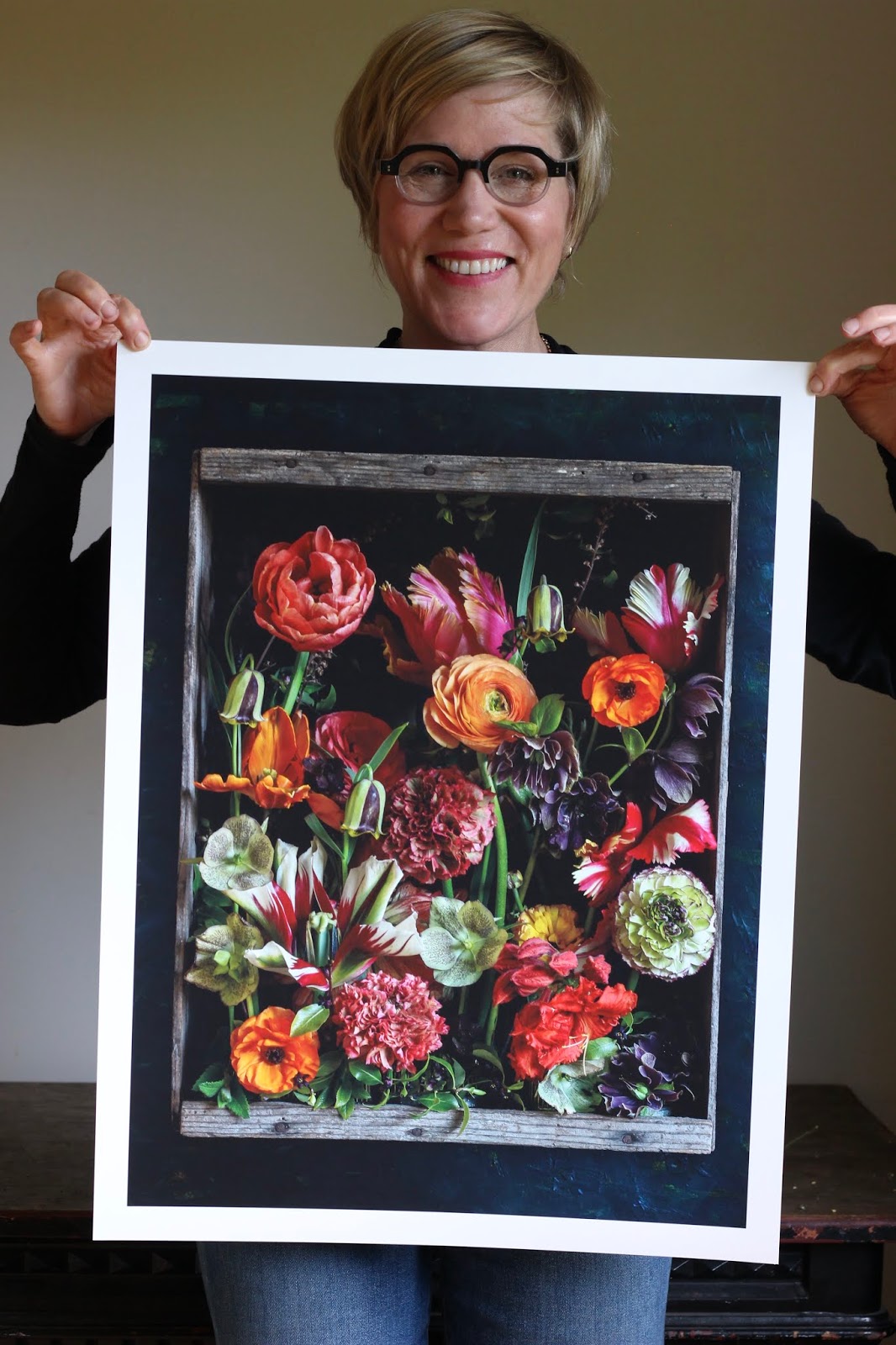
 When the speaking invitations arrived, I was ready; I built my talks with multiple short “stories” about flowers and the ways they connect us with nature, painting, history, ourselves—just as a good essayist, memoirist, or columnist might do on the page.

By the time the book deal happened—a book combining my photographs with short essays on style, creativity, and everything from Baroque music to wabi sabi to the psychology of colour—I not only had an audience who wanted to learn more, but also 20,000 of the 40,000 words needed for the book.

Photography was not something I’d ever truly wanted to learn, but now that I have, I’m grateful for its silence and the way it pulls me creatively. At first, I had to stretch to create images I thought worthy of an Instagram post, let alone a book, but as I learned to use a camera I found the art itself became another subject for inquiry, which is of course, always a good thing for an essayist. Long or short form.

Note from Lisa: You can connect with Christin at her website, and on Instagram, Facebook, or Twitter. You can find her book, Cultivated, at major online retailers, or order from Indiebound or through your local independent bookstore.


Monday, June 4, 2018

Guest Blogger Ele Pawelski on the Value of the Ubiquitous Writing Group

Ele Pawelski’s novella, The Finest Supermarket in Kabul, was published by Quattro Books in December 2017. Her short stories have appeared in the Nashwaak Review and Flash Fiction Magazine. A ten-year Toronto resident, this avid adventurer has also lived and managed human rights projects in Afghanistan, South Sudan, Bosnia, Kenya, Uzbekistan, and Kosovo. Ele teaches International Development Law and is writing her next book, a novel featuring parallel stories about a German mother and son trying to find each other after becoming separated during World War II.

Please welcome Ele Pawelski.

I found Moosemeat Writing Group long before I became a fiction author. Thankfully. Otherwise I’d probably still be a struggling memoirist.

In 2010, when I joined Moosemeat, I sought to expand my circle of friends and find a group of like-minded artists willing to help shape my ideas into something readable. The year before, I’d moved to Toronto after working overseas on development projects for twelve years and was still trying to find my footing back at “home.” I liked writing and a few friends suggested I put my experiences of life in post-conflict environments like Afghanistan and Bosnia into a book. I knew how to write academically, but creative writing was a different beast.

So I did what everyone with a problem does: searched online. Moosemeat’s website called out for writers of any ilk. I was in!

Moosemeat’s history goes back to circa 1995, when a group of committed writers wanted to continue meeting up after having taken a writing course together. The name was provoked by an animated debate over a story in which the main character has 10 pounds of moosemeat in a freezer. At least that’s what I’ve heard; Moosemeat membership has completely turned and the originators are long gone. Certainly the moniker gets a laugh, especially when we call ourselves meese or the herd

Eventually, Moosemeat would become the foundation of my writing accomplishments. But first, I had to get up the confidence to submit a story! I remember that meeting very well. I’d submitted a satirical narrative entitled, “Where Taxis Go To Die,” which poked fun at the poor quality of taxis in war-ravaged countries.

Moosemeat’s format is straightforward: in advance of every meeting, two writers submit pieces of less than 6,000 words, either a stand-alone short story or part of something longer. Generally, attendance is between four and fifteen individuals who provide feedback one by one. The writer also has a chance to speak at the end. In addition to regular meetings, once a year, the group collaborates on a chapbook of flash fiction stories and hosts a public reading for contributors. 

I could feel sweat gathering under my armpits. The critiques came fast and furious – it was overly funny, not enough of a story line, too little information about my work colleagues, not enough depth…I got sweatier. When it was my turn to talk, I barely said anything, crushed that my story didn’t seem to work for most members. Upon reflection, the earnestness of the reviewers was obvious; they wanted to help. And a lot of their comments were useful, if only to point me in new directions.

It got easier. Two more similar stories later, I was far less sweaty, and had determined that writing a funny memoir in the style of Bill Bryson was not going to work as I had envisioned. In the process, I read and critiqued a lot of short stories, and listened to the critiques of others. I started to see what worked and what didn’t work on the page. Notably, there isn’t always agreement amongst the meese, which confirms the absolute subjectivity as to how much and why a reader enjoys a certain story.

For example, during a recent critique, half of us thought a short story that ended with no character development was fine as it indicated the protagonist stuck to his guns, while the other half wanted to see some learnings. This kind of diversity signals it is crucial to write to a target audience. But more importantly, it hooked me on the value of other people’s opinions and how those could enrich my own writing.

About a year after being in Moosemeat, I sent out the first chapter of The Finest Supermarket in Kabul. I received an immediate, and very encouraging response via email: “Let me just say “wow!” The verbal feedback at the meeting was also quite positive, but in addition, the previous twelve months had prepped me to take all comments constructively. Over the following three years, I presented the middle and last chapters. Again, the critiques were affirming and helpful, and motivated me to dig deep in terms of a generous re-write when I put the story all together. While I could have submitted the rewritten chapters for further critique – no problems in doing this if a writer chooses – at this point, I felt the story was ready for more directed suggestions.

In exchange for wine, two meese agreed to look over the entire draft novella before I submitted to my publisher and give structural and big picture comments. After I signed on with Quattro Books and incorporated my editor’s suggestions, I convinced one more moose to give me line edits, and check for typos and verb agreement as the story had changed from past tense to present. Without this roster of beta readers, I would have been severely limited as to who I felt comfortable and confident in asking for this kind of help.

Moosemeat has no fees, and membership is fluid, ranging from authors with more than one book under their belt to aspiring novelists to writers who enjoy putting pen to paper but are not looking to publish. The only criteria are the willingness to give honest feedback and periodically submit a story.

Being part of a writing group has spurred my writing to evolve in ways I could not have imagined eight years ago: I’m confident writing in the third person and have tried out the second; I can fashion a decent story arc; I get that a twist at the end doesn’t always make for good reading; and finally, I treat writing more like a job than a hobby. The fact that meese are also excellent cheerleaders means I’m unlikely to drop out anytime soon. We each email the group with any good writing news, attend each other’s writing events, and go out for beers from time to time. What’s more to want from a bunch of random creatives!

Connect with Ele via her website, Twitter, or Facebook. Find Moosemeat here.

Monday, May 15, 2017

Guest Blogger Marjorie Simmins on Memoir, Starry Night Memories, and What She Learned from a Workshop Student

How I love the way the internet connects me to like-minded, interesting people across miles, borders, cultures. I was introduced to Marjorie Simmins, a Canadian memoir writer and fellow horsewoman, by Rona Maynard, a writer/editor (Canada by-way-of-New-Hampshire), with whom I've exchanged Facebook posts for years. Rona knew I would like Marjorie's memoir, Year of the Horse (Pottersfield Press 2016). Marjorie also writes essays for magazines, newspapers and anthologies in Canada and the United States, and divides her time between Nova Scotia and British Columbia. In Coastal Lives (Pottersfield 2014), she wrote about loving two coasts and one man, husband Silver Donald Cameron, a noted Canadian author. Marjorie is currently working on a third non-fiction book, which includes tips, essays, and interviews on memoir—an outgrowth perhaps of her many workshops.

Please welcome Marjorie Simmins.

“You forgot something,” says sharp-eyed Sara, a fine essayist and freelance journalist. She points to the flip-chart, on which I've written the day's itinerary. “That last one—'Starry Night Memories'—what's that?”

Sara is right, and she is wrong. I didn't actually forget, but we did run out of time, and in truth, I am relieved, as I haven’t presented that particular writing exercise to a memoir writing workshop before, and I'm not quite sure how it might go over. But I am busted now.

“Right,” I say, “'Starry Night Memories'...” I hesitate again, when I look up to see eight pairs of alert eyes focused on me, expecting some degree of teacherly articulation. You're supposed to be the memoir writing expert, I chide myself. So speak up.

“You know when you are in bed at night, you're getting sleepy, and your thoughts are moving around from subject to subject, and sometimes, from memory to memory?”  Two or three people nod.

Encouraged, I press on. “Sometimes you deliberately take out a cherished memory to visit, and enjoy. It's like an old friend you haven't seen for a while. You're happy when you think about it, and it helps you fall into a happier, more relaxed sleeping state.”

No nods this time, but several heads on a tilt; they're all still listening.

I struggle to underscore the main point. “So those memories—those 'starry night memories,' the ones we keep in our memory vaults—sometimes they're so much a part of us, they need to be written about.” I take a deep breath, wind up for the killer point: “You need to take those memories out from an inner place of safe storage, to a public place of recorded story. One memory could even be the starting point for an entire memoir.”

The group is silent, not a single head nodding now. But I trust this brainy bunch. They just need a moment.

“Ohhhh,” breathes Sara. “You mean our deepest memories – the ones that make us, ourselves.”

“The ones that are as much us, as our fingerprints or our voices,” adds another participant.

“The memory-stars inside us,” chimes a third.

“Yes,” I say. “Those.”
                                                                   
Then I feel that usual slither of fear down my spine – which is probably why I didn't want to do this exercise, hoped no one would notice its omission from our full day of learning and sharing.
                                                                   
More to myself than to the group, I hear myself say: “Of course once you write about those memories, you kinda lose them as your special friends in your own might skies.” I should hold back the next thoughts, too, but somehow I can’t. “Sometimes it feels like there are only a finite number of the most intense, writable memories. So you might … run out.”
                                                                   
A weighted moment of consideration by all, then Sara cries out: “No! That's not it. As soon as you set one memory free, another is able to rise up and take its place. It's like water coming up in our footprints on the beach. All those footprints, all that water and sand:  that can't be counted individually, any more than memories can. And think of this,” her voice is triumphant now, “why shouldn't the memory that comes up be even more special than the one you let go of? It certainly could be as special.”

I will not gasp. I will not cry. I will not sag with relief.
                                                                   
“Yes,” I say, with apparent calm, my interior landscape as a memory-hoarder forever changed. “I can see that, Sara.”

What I see, in fact, is what I've known for ages, as an essayist and a memoirist: the memories do change within after you've offered them up publicly, becoming less vivid in some ways, more substantial in others. Most startling of all, they go on to have their own separate lives apart from you, in the memories of those who read about them.

But I have guarded my deepest, most personal memories partly because they are so connected to people I love, many of whom have passed on, either from simple old age, or complicated early deaths; replaying the memories seems like the only way I can spend time with them. Hence the instinct to hoard. Mine, all mine.

Which goes against every writerly instinct to share stories, I know. Somehow I’ve worked around that, my lifelong need to write and share stories winning out over my fears of losing particular, beloved memories.

What startles me more than anything from Sara's outburst is the idea of memories-in-waiting. Archaeological layers of memories, waiting to be troweled up into the sun. Bonus! I have never before thought of memories as infinite. I am exhilarated and delighted … and a wee bit intimidated. I am used to corralling, then gradually sharing what I thought was a finite selection of memories.
                                                                   
I stand silently in front of eight pairs of intelligent, kind eyes, and I think: I could claim that whole vast universe of memory that exists within us all, and I could experience more beauty, feel more sustenance from my waking, day-skies, too. Balance, I think, it’s all about balancing then and now.
                                                                   
Aloud I say: Close your eyes for a moment. Forget that it's daytime. Settle into a pretend night sky. Stars upon stars. When you go to your memories, what are the bright constellations you always go to?

Eight pens find paper. When I give workshops, next to the epiphanies that often come with the sharing of ideas, these silent, working times are my favourites..I love to see writers write. We've talked in and around memoir for most of a day, sharing what fascinates and frustrates us about this saucy, renegade genre. Now it's time for quiet, and the recording of thoughts, perhaps of epiphanies, certainly memories – starry night and otherwise.

Note: You can connect with Marjorie via her website, on Facebook, at Twitter, and

*Marjorie's next memoir workshop, The Minefields of Memoir, is scheduled for June 17, 2017, at the Thinkers Lodge National Historic Site, in Pugwash, Nova Scotia. Information is posted at her site.


Friday, February 6, 2015

Friday Fridge Clean-Out: Links for Writers -- February 6, 2015 Edition

Prolific writer Jordan Rosenfeld, in a video hangout with Estelle Erasmus, talks about how she churns out so many essays that get published in so many, many places. Worth the 14 minutes!

> Is being "sponsored" (meaning more or less not having to earn a paycheck) the brass ring for writers struggling to find/make/take enough time to seriously pursue their projects? Start at the Brevity blog with this post, and then follow the links back to the original Salon post that got the conversation started, and sideways to a number of responses, both yay and nay.

> Interested in exploring Canadian literary magazines and journals? Here's a handy round-up (the post date reads 2013, but it was just updated last week).


> The Freelancer offers 17 journalism conferences worth your time in 2015.  (Including the ASJA Annual Conference, where I'm pleased to be on a panel about writing groups.)


> Poet Jessica Piazza is submitting only to paying venues in 2015, and chronicling (tumbling?) her experiences (plus talking with other poets and editors) at Poetry Has Value.  (hat tip Erika Dreifus)

> Another great listening experience - Donna Talarico, founder/editor of the online creative nonfiction journal Hippocampus, on the Higher Ed Social podcast, discussing juggling teaching and editing, and some interesting Hippocampus behind-the-scenes re: submissions, selection, etc.

> Looking for "feminist/inclusive" places to submit writing? The Fem has a list.  (hat tip The Review Review)


> Finally, I don't know a lot about literary translation, but I know what's funny about words, and I love this: Idioms that cannot be literally translated into English. Well they can be, but hold no figurative meaning.  Like: "There's no cow on the ice" from the Swedish.


Have a great weekend!

Image: Flickr/Creative Commons (Filipe Soares Dilley)

Monday, March 25, 2013

Guest Blogger Shaun Hunter On Going Public With Her Memoir Manuscript


Shaun Hunter's personal essays have appeared in literary magazines and anthologies, including Embedded on the Home Front: Where Military and Civilian Lives Converge (Heritage House, 2012). Soon, she'll be contacting literary presses about her memoir, Under the Skin. Shaun lives in Calgary, Alberta, Canada, where there are only 100 frost-free days per year. But on one of her trips south, we met at the Welcome Table Press essay symposium in New York City in 2011, where Shaun was one of the first writers to flag me down at a conference just to tell me she read my blog. Right then, I invited her to contribute a guest post, whenever she was ready. She's ready. 

Please welcome Shaun Hunter.

“You finish the book,” Janna Malamud Smith writes in An Absorbing Errand: How Artists and Craftsmen Make Their Way to Mastery. “It is time to reenter the world… It is tempting to turn around.”

I perch on this new place in my writing life: toes millimeters from the latest cliff edge, tempted to turn around. My book-length manuscript, five-plus years in the making, is “finished.”

I have completed other manuscripts – a graduate school thesis, and five biography books written for an educational publisher. Finishing those projects, I felt depleted, yet rewarded: deadlines met; degree conferred; contracts fulfilled. On to the next thing.

Not this time. After making the last edits to Under the Skin, a memoir about mothering, maternal legacy, and malignant melanoma, I thought I would feel buoyant, fired-up for the next leg of the journey. But the view from the edge of the cliff – a murky expanse fraught with rejection and indifference – is terrifying.

“Going public with your art,” author and psychotherapist Janna Smith explains, “is adulthood writ large: There is excitement, satisfaction, praise; there is also criticism, disappointment, and embarrassment.”

A mixed bag. The full meal deal of being a grown-up. A few weeks shy of my 52nd birthday, I’ve been around the block. I can usually spot the bright-green shoots of my own illusions and prune them back. I have thickish skin. Why is the prospect of going public with my memoir so paralyzing?

Last summer, my twenty-year-old daughter went hang-gliding on a backpacking trip in Europe. I heard about her adventure on Twitter, hours after she flung herself into a Swiss valley. At the time, I was relieved she hadn’t alerted me to her plan in advance, and glad I found out after she’d landed safely, unscathed and exuberant.

I went paragliding today! It was by far the most incredible thing I’ve ever done.

After the news sunk in, I realized that this determined, self-aware daughter of mine had checked off yet another fear on her list toward becoming an adult.
           
According to Smith, when it comes to artists going public with their work, many finish but proceed no further.

What about me? Am I going to be content with letting a completed manuscript sit in a drawer, or am I going to do what it takes to get this 200-page memoir to market? I’ve toyed with the idea of giving up, “living as a civilian” as the poet Shawna LeMay calls it. Like LeMay, during this long Alberta winter I have considered “surrendering in the same way a person who has hypothermia wants to go to sleep in the deepening snow.”

Bury the manuscript in the drifts of paper in my office. Hole up and write only for my own pleasure, sheltered from the snow squalls of rejection. Suss out another line of work. I know in my bones that none of these options is viable.

For years, I have been inching toward going public: workshopping essays in classes and critique groups, and publishing a few; reading my work to strangers; and most recently, pasting my shining face on my first website that identifies me as a writer.

I know that ego is going to push me -- and my manuscript -- out the door. After a decade of trying to absorb Buddhist ideas about egolessness and impermanence after my cancer diagnosis, this is uncomfortable to admit. But Smith’s book about the psychological dimensions of art-making emboldens me: I want to be seen. I care about being heard. It’s not a fantasy about being famous, but the pressing human need to be recognized and valued. “Few desires,” Smith writes, “are as primal.”

Of course, a publishing contract would be sweet compensation for my years of labor on this book; I will settle for active, visible participation. In a society caught up with “showing and spending,” as Adam Gopnik writes in a recent New Yorker article, I want to be part of a community of artists “devoted to seeing and making.”

Janna Smith assures me I can learn how to navigate the gaping canyon between private and public. Cultivate your saleswoman self, she suggests. Clothe your emotions in Gore-Tex. Summon bravado.

Get in the game.

After my daughter’s trip, she showed me the picture she snapped in mid-glide: her feet in a pair of borrowed sneakers dangling a hundred meters above solid ground. I could feel the mountain air press against my face, hear the snap of the nylon wing above me, sense panic gusting through my gut. In that glimpse into my daughter’s adventure, I imagined what it would be like to soar.

I have finished my manuscript. It is time to reenter the world. I will resist the temptation to turn around. I will strap myself to a sturdy, wind-worthy sailing craft, and step off the cliff into my adult life.

Again. Always.