Showing posts with label flash nonfiction. Show all posts

Tuesday, May 26, 2020

Guest Blogger Christin Geall on Insta-prose: Developing an Audience Through Images

Christin Geall is a Canadian writer, designer, photographer, and author of Cultivated: Elements of Floral Style (Princeton Architectural Press, 2020). Her writing and floral work focuses on the intersections of nature, culture, and horticulture, and she teaches internationally. Trained in horticulture at the Royal Botanic Gardens, Kew, she completed a BA in Environmental Studies & Anthropology and a MFA in Writing (at the Stonecoast Program in Maine, which is where we met), and has been a writing professor and gardening columnist for Gardenista. Architectural Digest called her book “delightfully vibrant” and the Seattle Times recently quipped "Geall might just be the M.F.K. Fisher (American grande dame of food writing) of flowers." 

Please welcome Christin Geall

Flash nonfiction? The segmented memoir? The prose poem? When I was in graduate school studying creative nonfiction, I mastered none of these forms. Despite a background as a lifestyle columnist and editor, I couldn’t write both poetically and short. But I yearned to, so I studied stylists like Abigail Thomas, MFK Fisher, and Annie Dillard.

To get one thing straight right away: I’m a terrible storyteller. And not a great consumer of aural nonfiction stories, either. At dinner parties I’d sooner listen to someone tell a tale as watch them pick their teeth. I like ideas, conversation, and a bit of banter, yes, but I didn’t think myself ironic enough, clever enough, or frankly even online enough, for Twitter. And Facebook, well, I found it either too political or too congenial for decent exchange of thought, much less story.

Enter the image as a writing prompt. A subject for discussion, and suddenly all my storytelling and audience problems were solved. Looking back on how I accumulated 97,000 Instagram followers, and the success of my recent book Cultivated: The Elements of Floral Style (Princeton Architectural Press, 2020), I see now how my training in the micro-essay changed my career as well as my relationship to nonfiction.

I had evolved into a personal essayist, memoirist, and an academic by the time I joined Instagram in 2015, yet I had always struggled to write the longform pieces that my career required. I did possess a deep knowledge and love for plants, so I had thirty years of passion to write about, in addition to a fascination with the ideas and language of the fine arts. Creativity is universal—what I’d learned in grad school about the process of writing, workshopping and critique, I applied to my work with flowers – and then to how I’d tell short stories around them.

On Instagram, where a post is driven by one image, you are limited to 2,200 characters, or roughly about 350 words. Given I’m more sprinter than marathoner, the platform fit. Those 350-ish words, I found, are ample space for a concept to be explained, an idea explored, or even a bit of narration.

As I lobbed ideas to a hash-tagged audience and reflected on their comments, I found my thinking (and opinions) refined. As I encountered friction, or clarification, I entered into conversation. I made friends, of course, learned, networked, and steadily over the past few years, became a sought-after voice in my field.
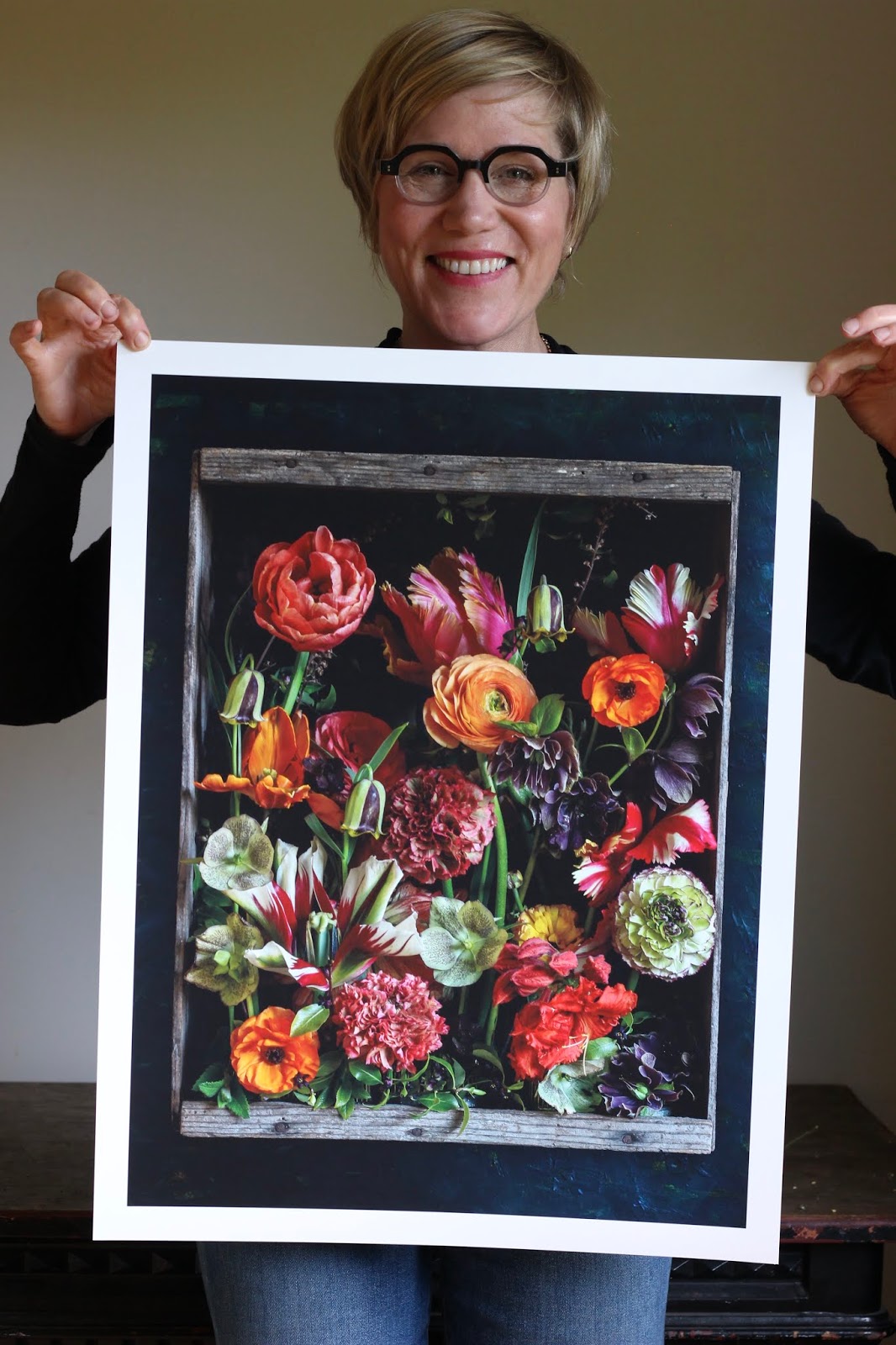
 When the speaking invitations arrived, I was ready; I built my talks with multiple short “stories” about flowers and the ways they connect us with nature, painting, history, ourselves—just as a good essayist, memoirist, or columnist might do on the page.

By the time the book deal happened—a book combining my photographs with short essays on style, creativity, and everything from Baroque music to wabi sabi to the psychology of colour—I not only had an audience who wanted to learn more, but also 20,000 of the 40,000 words needed for the book.

Photography was not something I’d ever truly wanted to learn, but now that I have, I’m grateful for its silence and the way it pulls me creatively. At first, I had to stretch to create images I thought worthy of an Instagram post, let alone a book, but as I learned to use a camera I found the art itself became another subject for inquiry, which is of course, always a good thing for an essayist. Long or short form.

Note from Lisa: You can connect with Christin at her website, and on Instagram, Facebook, or Twitter. You can find her book, Cultivated, at major online retailers, or order from Indiebound or through your local independent bookstore.


Friday, August 25, 2017

Friday Fridge Clean-Out: Links for Writers -- August 25, 2017 Edition

> Flesh out your fictional characters by thinking of them as...horses? Yes, says Roz Morris.

> This Quartz piece's stance is a bit strident, but I do agree that sometimes talking, talking, talking about writing projects can often drain them of creative energy. 

> Indivisible and the Op-Ed Project offer some tips and guidelines for writing editorial advocacy materials (scroll down).

> Literary journals open and close to submissions according to predictable--and often unpredictable--schedules. AuthorsPublish offers this list of journals that are always open.

> Ever have someone scrawl in the margins of your work: Head Hopping! or POV shift? ...and not be precisely sure what this means or how to avoid it? Here's a primer.

> Brag Box Times Two: 
           Since I'm already partial to stories in which the weather is a kind of character, that makes this flash piece, written by my former MFA student Bethany Petano, twice as nice.
           Many congratulations to my former client Kathryn Sollmann, on her book contract with Hachette for Ambition Redefined: Creating Lifetime Security (Without Neglecting Your Family or Yourself) in a More Flexible Workplace. It was a pleasure working with Kathryn on the book proposal that helped her land the agent who sold her book! 

> Finally, you have until August 26 to leave a comment on Melissa Palmer's guest post and maybe snag a complimentary copy of one of her books.


Have a great weekend!


Thursday, March 30, 2017

Recognizing When Life (not writing) Could be the Start of a Beautiful....Essay

The actual dress, made to twirl.
If I weren't already a natural born advance planner (or an annoyingly, meticulously, obsessively detail-oriented nag, as my kids and husband might say, eyes rolling), my former career in public relations would have transformed me anyway.

Like many magazines, I often run a few months ahead of schedule. So since I'll be presenting a one-day event on writing short nonfiction prose in May, and a submissions class over the summer, I'm gathering examples for both. Some are my own work because that way I can answer student/writer questions, and by sharing my writing / revision / submission / rejection / acceptance process, I believe I can be helpful to others.

This past Monday, my 250-word work of flash nonfiction, "A Dress for the Wedding," appeared on the River Teeth website, in their Beautiful Things column. I think I'm correct in saying this is a somewhat coveted spot for many creative nonfiction writers, and I'm extremely proud about this particular publication.

Here's how that happened.

In many ways I went about this as I did when working to break into Brevity Magazine with this piece. (I went on to describe that writing/submission process here.).

One of the keys was not trying to slice a small chunk out of an already written long piece. Flash, I've come to understand, needs its own place to, perhaps ironically, expand and breathe, to open up space between sentences, even as it carves away.

The other thing I learned is that, for me anyway, short pieces are more often suggested by something I experience or remember independent of the act of writing. In other words, life is probably the more generous well for these short flashes, not editing.

The dress piece began with notes scratched in the tiny notebook I keep in my purse—while in the ladies' room at the wedding. Having gotten drenched in a downpour walking back from the church to the car, I ducked in the restroom as soon as we got to the reception venue to try to salvage my hairstyle.

It was while looking in the mirror, and twisting to get a glance at the back, when a few things happened. I realized (1) The blowout is a total loss, and (2) This dress was exactly the right choice. Then (3) A cascade of images: turning around in the dressing room at the store…showing my husband the dress choices in our bedroom…all my rules about dressing as a fat middle-aged woman…then: (4) Wait – there's an essay in this…somewhere.

I jotted a few notes. When Frank and I danced an hour later, and I found myself twirling, I had the rest of the piece. So it was back to the ladies' room, a few more notes, and then—I forgot about it.

Forgot on purpose. I wanted it to marinate. Then I returned to it, wrote a draft, read a bunch of past B.T. essays, and revised.


This was my second submission to River Teeth's Beautiful Things; the first, from 2015, was rejected. When I went back to read it again, I realized it didn't stand up so well on its own, and it wound up being absorbed into my memoir manuscript, where it probably originally belonged.

Figuring out how to write for very limited word counts, what to write for which short-form venues we aspire to be published in, and where to send off what we write, are arts that are always evolving. I'm still learning. And though the "rejected" column in my submission tracking spreadsheet is routinely, robustly full, occasionally I do get it right.

And then of course, I annoyingly, meticulously, obsessively record all the details. For any future reference.

Monday, March 13, 2017

A TV Friends Reunion Essay: The Ones About How it Used to Be


Here in New Jersey, we're expecting a major snowstorm to begin tonight, with possible accumulations up to two feet. I'll be peeking out the window tonight, likely at 2:00 or 3:00 in the morning (I don't sleep much), while I'm intermittently reading, finishing some needlepoint, or scribbling feedback on student work. 

But in the background: my own version of nostalgia TV, shows from the 1960s and 70s. I don't have to watch every scene, because I know those characters, I love those characters; I'm comfortable in their company. Recently, I started to think about why. And so of course I wrote about it.

The essay, "Reminiscing with my TV Friends," appears today at The Sunlight Press.

Here's an excerpt:

"...I began to linger. Then to seek out those old shows. Slowly, I understood: I was revisiting a time when I had a beautiful mother who walked this earth, a time when a cool aunt waited for her pimply chubby niece on Saturday nights, a time when a kind father never ran out of time for me, when my lovely now-67-year-old sister was as fresh and young as Patty and as unlined and peachy as Laura Petrie. I’m revisiting, even more than all of them—myself."

You can read the entire (short) essay here.

Short pieces like this, which is just under 750 words and is often called "flash nonfiction," will be part of the focus of a day-long writing event I'm leading in early May.


Image: courtesy The Sunlight Press


Tuesday, February 28, 2017

A Jersey Day in May: Announcing - The Art of Short Nonfiction Prose. Write with me!

I know it's just a trick of the senses, that the unseasonably warm weather in northern New Jersey the past few weeks is lulling me into the false idea that spring is already underway. Which leaves me eager to traverse the intervening weeks to arrive at May 6, when no matter what, spring will be firmly in bloom in the Garden State.

I'm very happy to announce that I'll be leading a full-day writing event in Bedminster, NJ, on Saturday, May 6 -- The Art of Short Nonfiction Prose. Everything about the day has been thoughtfully arranged for an intimate, challenging, supportive, and edifying experience. 

We'll be welcoming about 10 to 12 writers, who will come together to explore ideas, generate new work, share, learn, and in short (!), dive deeply into the craft of writing short nonfiction. Short, in this context, will include the newer forms of mini-, micro-, and flash essays (from 50 to 750 words), as well as more traditional "short" pieces that are more than flash but less than long-form.

The Art of Short Nonfiction Prose will take place in a lovely countryside setting, and it's sponsored by Tiferet Journal. Tiferet (tagline: Promoting tolerance through literature and art) was founded and is published by Donna Baier Stein, my teaching colleague in other endeavors, and a champion of literary work that has meaning.

I'll be assisted by Ryder Ziebarth, who is a former student/mentee of mine, a graduate of the Vermont Center for Fine Arts MFA program, and a Tiferet associate editor. In fact, Ryder is hosting the event at Cedar Ridge Farm, which goes back generations in her family and is listed with the Smithsonian Institute of American Gardens. In addition to her expertise at nonfiction, Ryder is a dedicated steward of the land, and an accomplished cook (who's planning to serve a healthy farm-to-table lunch!).


I've spent time at her farm, and I'm certain that the gracious farmhouse, welcoming guest cottage, and spacious grounds, along with the lush gardens, and rolling hay fields will be a perfect backdrop. It's a place for deep thought, quiet contemplation, relaxed conversation and also the kind of spirited camaraderie that so often springs up between writers brought together for common purpose.

If you're within driving distance, and you have a desire to dwell for a full day in the possibilities that short nonfiction allows, and do so alongside other like-minded writers, then I invite you to check out this unique event. (Enrollment is limited. I'd be happy to answer any questions, here or via email.)

As March approaches, and who knows what its winds may bring, I'll enjoy knowing that spring will arrive, and with it, this special day.

Images: courtesy Ryder Ziebarth

Thursday, January 19, 2017

Guest Blogger David Galef on: One Solution to a Lot in a Little Space -- The Flash Vignette

In the world of creative nonfiction, where I swim most of the time as a writer, brevity is not only a craft goal, but also closely associated with Brevity: A Journal of Concise Literary Nonfiction. What follows, however, is a post adapted from a new fiction craft book, entitled, yes, Brevity: A Flash Fiction Handbook.

Now that we've cleared up any possible confusion, I'm pleased to introduce the book's author, David Galef. David is not only a fellow New Jersey writer and an accomplished author, but also the head of the creative writing program at Montclair State University, where I teach on and off (at the moment, I'm "off"). David would argue—and I agree—that much of what he offers in his new book is equally applicable to narrative nonfiction, as it is to fiction writing. I'm finding it particularly helpful myself, as I'm revising my first two pieces of fiction—one a medium-length short story, and the other a piece of flash which, like this introduction, is crying out for, well, brevity.

Please welcome David Galef

            By definition, flash fiction is rendered in miniature. But what happens when you start cutting down on words? What becomes of plot, character development, and thematic depth? Obviously, some of what you can attain in a longer story is going to have to go. Forget the long landscape description or the three scenes showing the grandmother’s slow decay from Parkinson’s. On the other hand, some treatments are particularly suited for the short run. One well-known form is the vignette.

            The vignette started in fifteenth-century printing as a decorative border of vines around a page, then turned into what the vines enclosed, usually a page with an illustration. We now think of it as an illustrative scene, a literary sketch. The French coined a term for this form, calling it tranche de vie (literally, “slice of life”), and its ingenuity lies in what any cross-section reveals: the hidden depths of an interior view.

            Picture two eight-year-olds playing croquet: those unwieldy mallets, the lawn sloping unfairly, and one ball headed for the bushes. This vignette, just begun, might be called “Game.” It shows the seemingly innocent fun had by two small children on a Sunday afternoon, with more than a hint of pre-tween rivalry. We’ll name the children Ivan and Sandra and make them neighbors. You can hear the smack of mallets on the balls along with some conversation about school. But after the first paragraph, Ivan says something nasty about Sandra’s mother. Sandra responds not by hitting Ivan’s ball with hers but by kicking it. The “game” escalates from there.

            As you can see, “Game” isn’t a story with a proper beginning, middle, and end. It’s a moving picture that becomes a sketch or scene, suggesting something beyond. The term “sketch” is all the more apt when you think of visual art, in which a sketch is the essential lines of a drawing, but not filled in.

            Here are some guidelines for creating a vignette:

            Focus on a moment. If you start to chronicle any substantial duration stop, and instead deepen the presentation of what’s already there: waiting half an hour for a date to show up, a missed five-minute opportunity to help a stranger.

            Develop only as much as you need to register an impression of either a character or an event or even a mood. One trait indicates a sunny personality; a distorted shadow indicates trouble.

            Think in psychological terms. Your sketch has a meaning beyond its mere existence because of what it represents: an old woman who can’t enjoy a summer afternoon, a boss who won’t take no for an answer. Here are five pointers for this kind of treatment:

            1.         Don’t merely describe. Follow the action. Dramatize.
            2.         Do more with less. One short scene from a day is plenty.
            3.         Be representative. One small portion can stand in for a whole life.
            4.         Go for evocative, concrete details, not abstractions.
            5.         If possible, find a way to give shadows and depth to your sketch. Make it mean more than what it seems on the surface.

            If you're interested in trying a vignette, Here are a few exercises:

            Think of yesterday as a sequence of events. Then choose a common incident, such as lunch, an hour at work, or a car ride. Now describe it, animate it, and dramatize it so that the reader gets a vivid picture of what’s going on, on both an exterior and an interior level.

            For instance: With a smile, I serve plate after plate of the daily special, spaghetti and meatballs, at Abe’s Diner, but I really hate my job. Or: She hitches a ride home with a coworker, a man she’d like to ask out, but she hasn’t got the nerve.

            What incident did you choose, what did it show, and why was it significant? How much of the character did you reveal, and in what ways? Did anything change over the course of the event?

            Try conveying emotion or attitude in miniature. Here are some specific directives: What slice of life—the more ordinary, the better—would you use to show envy at the way your parents treat your brother? How good does your friend think she is at driving versus how inept she really is? Why is that man on the curb accosting passersby by asking the same question over and over?

            When your vignette is complete, you’ll know it, or your readers will. From one angle, it may look like a line segment, a point that travels from A to B. But viewed as a segment cut from the whole, it’s character dealing with event in a way that reveals the line as a lot longer, back into the past or into the future. A good vignette extends far beyond its narrative span; it displays a life.


David Galef has published flash fiction in AgniSmokelong QuarterlyNANO Fiction, Norton’s Flash Fiction Forward, and in his book My Date with Neanderthal Woman. He is the author of the novels FleshTurning Japanese, and How to Cope with Suburban Stress; edited an essay anthology, Second Thoughts: A Focus on Rereading; and co-edited the anthology of fiction, 20 over 40. His essays and reviews have appeared in The New York TimesNewsday, and  The Village Voice, among other places, and he is a humor columnist for Inside Higher Ed.  Connect with David at his website and via Twitter

Tuesday, October 4, 2016

When a Themed Submission Call Prods a Story

September was such a busy month for my writing that I've not yet mentioned—not here on the blog anyway—one publication that made me particularly proud. Those who write and read creative nonfiction, and especially fans of short works, know the quality of the essays and nonfiction narratives at Brevity, all presented in 750 words or less.

I'm so pleased that Brevity chose to publish my work, "On the Near Side of the Tracks," in their Fall 2016 issue, which had a special focus on race. What makes this slightly more gratifying is that this story—though the actual experience lasted less than 10 minutes—was one I sat on for years, not knowing precisely how or when or where to tell it.

When I came across the Brevity themed call for submissions in the spring, something slid into place in my head—and eventually, onto the page. I believe that's true for some stories: we wait and ponder and think, and wait some more, often not sure if it's ever going to live on the page. Then, something clicks and we "suddenly" know how to write about it, where to send it, and that it's time to tell it.

I'd love it if you took a few minutes (really, that's all it takes to read 750 words!) to read it. While there, perhaps take a bit more time to read some of the other stellar work in the special Brevity issue, which includes work by Deesha Philyaw, Roxane Gay, Tyrese Coleman, and several others, all with unique perspectives.

I'd been chasing a Brevity byline for a while, undaunted by a half-dozen rejections before this wonderful acceptance. That's not unusual, that's the writing life. Whatever you're chasing, I hope it shows up in your writing life.

UPDATE (10/19/16): Over at the Brevity blog, you can now read about the steps I took to nail this long sought after acceptance

Wednesday, May 25, 2016

Memoir Excerpt: Flash Nonfiction at Litbreak

Among my latest published online works is the short nonfiction piece, "Searching for Silvio," which appeared at Litbreak a couple of weeks ago. 

It's a tale about the odd things we do when someone we care about asks us to; about how, if we're honest, we do one thing but we are all the time really doing something else entirely; and about the unusual and unexpected ways grief and memory find their way into almost everything. It's also about bonds between siblings, the lifelong desire to be loved, and the gift of quirky and sometimes bothersome relatives.

Here's a small excerpt:

"First, I recruit Lenore, my best friend of 45 years, who loved my father, knows all about his dippy relatives. We canvass the hangouts, asking counter clerks and old geezers if they know my uncle, and some do, but no one has seen him in days. They call us doll and honey and give us buttered rolls and donuts. At the Hot Grill, I order a frankie-all-the-way-one. But we don’t find Silvio."


Friday, June 26, 2015

Friday Fridge Clean-Out: Links for Writers -- June 26, 2015 Edition

> Eleven video recordings are now available online (at no charge), of panels and presentations from the Fourth Annual River Teeth Nonfiction Conference held in May.

> As the resident writer in the family, do you "ghostwrite" relatives' and friends' remarks (eulogies, toasts, etc.)? Hey, there's a business plan for that.

> Have you seen Manuscript Wish List yet? It's where some agents tell us what queries would make them happy, from the expected ("more upmarket fiction") to the highly specific, ("a nonfiction book proposal on women in the circus.")

> Susan Shapiro's article, "9 Ways to a Faster Book Deal," is packed with useful information. (The way I read it, "faster" here doesn't only mean speedier, but a smarter, more strategic, more likely to succeed path to publication; but maybe that's just me.)

> I've been doing a lot of flash (micro, short, brief) writing assignments with my students -- and on my own. Paragraph Planet limits writers to 75 words.

> One author's game plan for a sell-out hometown book signing event. (Probably most relevant if you're writing on regional topics, but many useful general tips too.)

> This list of advice for memoir writing has a lot of value. Especially # 13: "Time is your friend." Slowing down, so important.

> The other day, I posted about one aspect of my submission process. At SheWrites, Emily Lackey offers another system for a submission wish list.

> Do you write humor and want to (no kidding!) earn a paycheck for it? Here are eight markets.

> If you're traveling to Massachusetts this summer, here's a new bookstore you (or your innerWimpy Kid) might like.

> Finally, Shannon Reed's hilarious piece, "If Jane Austen Got Feedback From Some Guy in a Writing Workshop."  And Nathaniel Tower tells us "What Common Rejections from Publishers Really Mean" (and I sure hope he's wrong!).


Have a great weekend!


Image: Flickr/Creative Commons - Wonderlane

Friday, March 27, 2015

Friday Fridge Clean-Out: Links for Writers -- March 27, 2015 Edition

> On their web "channel," the Los Angeles Review of Books is publishing a new literary journal, The Offing. And they're paying (a little), and the first wave of submissions was so strong, they're already closed to more (but re-opening on March 30).  (via Harriet Blog/Poetry Foundation)

> Literary Hub, set to launch on April 8, an effort by publishers, bookstores, publications, and literary organizations, promises it "will feature original and curated content about books and the people who write them, read them, love them."

> Poets & Writers has an app  for keeping up with New York City events. 

> Congratulations to (one of my mentors) Leslea Newman on the republication of her once-groundbreaking book, Heather Has Two Mommies. Get to to know Leslea a bit through an essay to her teenage self over at Dear Teen Me (also a great place to study the second person essay form).

> At Vela, Kelly Sundberg names eight flash nonfiction writers she's crazy about (with links to some of their most interesting pieces).

> According to Deadline Hollywood, one of Joan Didion's most iconic essays, "Goodbye to All That," has been optioned for a feature film, as has her novel, A Book of Common Prayer.

> Check out this "Freelance Rates Database" at Contently's The Freelancer site (and, if you have a recent paycheck for a media venue not listed, they'd love to hear and add it, anonymously of course).

> This one's from November, but I hadn't seen it yet. Over at Just English, a list of "18 Common Words You Should Replace in Your Writing". (Or, everything I usually cross out on student work!).

> If you're thinking of attending the annual conference of the ASJA (American Society of Journalists and Authors), today is the final day to register with the early bird discount. (And if you do, I'm on a panel on Saturday morning, and would love to say hello in person!).

Have a great weekend!

Wednesday, November 12, 2014

Of Print, Pixels, and Publication

I've gotten used to posting a link when something I've written has found its way to publication; even when a piece appears in a print journal, there's often an online version too. But not always. Since I'm a writer-who-came-of-age-in-the-time-of-typewriters, there's a part of me that finds a print-only publication quite satisfying. But since I'm also a writer-who-has-adapted-and-loves-the-online-world, it also feels a bit odd.

"The Nurse We Needed" is a piece of flash nonfiction excerpted from my memoir manuscript, and appears in the Fall 2014 issue of The Healing Muse (volume 14). When the package arrived with my two contributor copies, I had a sense of nostalgia…postal mail, the printed word, the glossy cover, the discovery of fanning through the pages, the small thrill of flipping back and forth from table of contents to contributor bios to individual random pieces of fiction, nonfiction, poetry, and artwork.

Okay, enough nostalgia. I'll admit too, there was a smidge of disappointment that I couldn't oh-so-easily put up a link to my work. But that soon passed.

Then I was on to my usual habit—scanning to see if any writers I know and/or admire also have work included. I don't know why this makes me so happy when it happens. It's not about validation (okay, that's a lie, if I found myself in the same journal or anthology as, say, Joan Didion…) so much as knowing I'm in this literary world together with other kindred souls.

Immediately, I found two brilliant, linked pieces of  micro flash nonfiction by Rita Ciresi, a colleague and fellow MFA faculty member. I also recognized several other names in the nonfiction listings, and a smattering of those in the poetry section as well. Next, I read randomly from all over the journal, and admired some of the visual art, too.

The Healing Muse is produced by the Center for Bioethics and Humanities at the Upstate (NY) Medical University, with a focus on work about illness, health, loss, the body, hospitals, healthcare, grief, sickness, care giving, medical workers, and other related topics. There is plenty of good work in this issue, representing so much rich experience. 

Editor-in-chief Deidre Neilen wrote in her Editor's Note, "Here is another paradox: the journal feels so light in my hands, yet it contains the weight of complex histories and the impossible questions they provoke."

My piece feels that way, at least for me: it's about what little I know actually happened, what I surely can never know, and what I imagine might have happened between my father and the hospice nurse who saw him only once, and very shortly before he died, alone.

Three weeks ago, I had made plans to participate in a reading and 14th anniversary celebration on the Upstate Medical campus, adjacent to my undergraduate alma mater, Syracuse University; it seemed an ideal quick road-trip getaway. But the universe laughed, my plans folded, and so now that I can't post a photo from the event, and instead of a link to my work, here's the page where you can buy a copy of the Fall 2014 issue of The Healing Muse ($10). Or maybe you have a piece of work you'd like to submit.

I'd also like to give one blog reader a copy of the Fall issue. Just leave a comment by midnight on Tuesday, November 24 (must have U.S. postal address and a trackback web contact).


Wednesday, March 19, 2014

Writers and Their Coffee: All the Regular Reasons, Plus Mine

It won't startle anyone to find a writer with fingers on keyboard, a cup of steaming coffee within easy reach.

I start my day in my home office with a cup of coffee, and I look forward to it. As the day unspools, I head down to the kitchen to refill my oversize mug whenever I need a mental break from the awful draft on the screen, or when the draft in my older house nips at my ankles, or I know that if I don't unfold my legs soon they may refuse to hold me up in a few hours.

But I'm not a coffee hound, not even a gotta-have-my-coffee-or-I'm-grumpy girl. (I'm grumpy in the morning, but it's not about coffee.) Coffee lovers, true coffee lovers, will find the following appalling: Though I won't turn down an expertly blended cappuccino from a skilled barista, I don't care what brand I drink, at home I drink instant, I dump two Splenda packets in the cup, and use only skim lactose-free milk. And  – I drink only decaf. 

That's because other than savoring the way that first cup warms me on a chill New Jersey winter day, I'm fairly sure the only  reason I drink coffee is that it helps me feel closer to my father. And it was always thus: my coffee habit (three or four cups a day most days, less in the summer), began wholly as a way to share something with him, decades ago when it seemed we weren't sharing anything.

But like many revelations in the life of a writer of memoir and personal essay, I did not understand this at all until I had a brief experience I could have discounted and forgotten. But writers of personal nonfiction don't do that - we file things away, and pull them out for reasons we don't always understand. That's what happened: I had an unnerving, but in retrospect, lovely experience surrounding a cup of coffee a few weeks after my father died—and then weeks after that, I began to write about it. That was seven years ago. 

I tinkered with that flash nonfiction piece about coffee sporadically for a few months, then put it away. For a long time. I’m not sure if I did that on purpose—following my own advice about creating mental and emotional distance from both the experience and from the early draft, so I could revise/rewrite it properly later—or if those early paragraphs perhaps felt too flimsy to develop into anything, or too personal.

But the event (which lasted just a little over an hour), and the feeling that triggered the essay (which lasted for years), finally nudged me to work on it again. I had to be attentive to the line between sentiment and sentimentality. I worked on it again. And again. Got some feedback, tweaked, and then understood that I had a place for it within a much longer essay in my memoir manuscript.

I began to send the short flash piece out last summer, and I'm so pleased that Gravel Magazine liked it enough to publish it in their March issue. I'm also happy that the editor chose this photo of my father holding me, to accompany it. 

If you've ever spent time in a coffee shop and maybe had a strange encounter while there, or you've felt that someone who was gone was in some small way still there, I hope that you will take a few minutes (it's that short) to read "Coffee Regular."

Top image (coffee cup):  by Waferboard via Flickr Creative Commons; Photo, bottom, Lisa Romeo, all rights reserved.

Tuesday, November 5, 2013

Looking Inside: Creative Nonfiction in the Fall Issue of Compose

Excuse me for kvelling just a little. (Can an Italian Catholic girl kvell? Nevermind.) I'll just say the Fall 2013 issue of Compose journal is now live and it's lovely. I began as creative nonfiction editor this spring and from the start I knew that founder/managing editor Suzannah Windsor (I interviewed her here), would make sure every aspect of it was excellent, and I've loved being part of a group of editors who are interesting folks.

It's been fun, instructive, challenging, frustrating, and surprising to be involved in my first issue from start to finish – soliciting, reading, selecting (and yes, declining – that's the frustrating part), and editing. I'm proud of the CNF pieces which appear, and working directly with the writers of each piece was one of the most gratifying things I've ever done – and I'm jazzed that I get to do it again for the Spring 2014 issue, and again.

Here's a little tour of the creative nonfiction section.

Because it's likely to make you a little sad in a very good way, depending on the type of person/reader you are, either begin or end with Eliana Ramage's lovely short essay of remembrance, 26 Tea Lights.

Then turn to Lori Horvitz's Little Pink Hatchling, a tale of a college coupling and the messy ways it continues, and doesn't, and does, and ends. Plus, a side of Italian ice.

If you've ever inherited something from a loved one – and then that treasured item was lost from your life  – you will understand the heart of Milena Nigam's Stolen Family Jewelry, and Other Gifts. Actually, I take back the part about inheritance. Anyone who has loved and lost – anything – will find her/himself in Milena's story.

I love a piece of prose that feels like poetry, but is also very clearly creative nonfiction, a piece with brevity and verve, snap and grit, a little mystery and moxie, and that's what Lita Kurth brings to Red on White. Hard to describe, so I won't:  Read it and you'll get it, and be glad you did.

Finally, listen in on Ana Consuelo Matiella as she muses on a certain aunt from her Mexican childhood, an image on a bottle of tequila, and a sudden midlife shift, in La Viuda-The Widow. The turn at the end is delicious.

There's fine fiction and poetry and artwork on offer too, as well as features and craft pieces to feed the writer, from three favorite nonfiction writers/teachers: Marion Roach Smith on Time Management;  Beth Kephart with an excerpt from her new memoir writing book; and Katrina Kenison on the value she found in a reader's nasty email.

Take a look. Read. Maybe submit something to Compose for the next issue. Or submit anywhere.


Many people have said this, and I always wanted to believe though had my doubts, but now I know it's true:  Editors everywhere, at every journal – are waiting, hoping to find something great, something unexpected in the submissions inbox. Surprise one of them.

Friday, November 16, 2012

Friday Fridge Clean-Out: Links for Writers, November 16, 2012 Edition


> The National Book Awards have been decided. All the winners and nominees, with links to excerpts from each, are at GalleyCat.

> The upside of being stuck in traffic: catching an NPR interview with Barbara Kingsolver talking about her newest novel, Flight Behavior - which by the way, has the glorious opening line: "A certain feeling comes from throwing your good life away and it is one part rapture."

> Now that the Silver Linings Playbook is in movie theaters, I'm reminded that Matthew Quick, author of the original novel, wrote a guest post for this blog back in 2008, about meeting readers during the early leg of his debut book tour.

> In a Bookslut interview, Dinty W. Moore, author of The Rose Metal Press Field Guide to Writing Flash Nonfiction: Advice and Essential Exercises from Respected Writers, Editors, and Teacher, has this to say: "...I'm almost always scrapping my beginning and ending somewhere in revision, because it is somewhere in revision that I begin to realize what it is I am trying to say in an essay, and thus for me to nail it, to get it as nearly-perfect as can be, I have to start somewhere new, and often end somewhere other than where I thought I was going."


> I was introduced to the Reddit feature AMA (Ask Me Anything) months ago by my teenage son. The idea is, an expert of some sort, or at least someone others want to ask questions of, agrees to answer any inquiries readers toss at them for a specified period. Last week, there was an AMA with Jane Friedman, former publisher of Writers Digest and current web editor of the Virginia Quarterly Review.


> If you are one of my New Jersey contacts, you know I can't stop talking about my upcoming teaching assignments at The Writers Circle. Yesterday I wrote about TWC's director, novelist Judith Lindbergh, and her turn as expert commentator on the History Channel documentary series Mankind. Such fun to know such interesting people.

Have a great weekend!