Showing posts with label guest posts. Show all posts

Tuesday, June 16, 2020

Guest Blogger Shelley Blanton-Stroud on Fact and Truth, Fiction and Nonfiction


Shelley Blanton-Stroud grew up in California’s Central Valley, the daughter of Dust Bowl immigrants. She teaches college writing in Northern California, consults with writers in the energy industry, co-directs Stories on Stage Sacramento, and serves on the advisory board of 916 Ink, an arts-based creative writing nonprofit for children. Copy Boy is her first novel. She also writes and publishes flash fiction and nonfiction, including pieces at Brevity and Cleaver.

Please welcome Shelley Blanton-Stroud.

It took me quite a while to figure out what my book, Copy Boy, would be, my trouble mostly arising from the gap between fact and truth. Facts are verifiable things. Truth is the meaning an individual makes of the facts we choose to consider.

I first began to write ten years ago by focusing on my own family’s history of moving west to California from Texas and Oklahoma in the Dust Bowl exodus of Okies looking for work in the Great Depression. I was thinking about a memoir because I had access to the facts. My father, especially, had dramatic stories to tell, one of which now sets my book in motion. But it soon became obvious that the “facts” changed in his every retelling—how old he was, exactly where the incident took place. And the facts really changed when my father’s siblings shared their versions of the family story. That’s what happens with memory and with storytelling. Though I knew my father was telling his truth, I was unsure of what the facts really were. I didn’t think I could get a memoir right.

So, I decided to turn to traditional historical references—books and newspapers about the Dust Bowl/Great Depression period in California—for a more-complete context on my family’s life. But there was often so much missing in these sources—the feel of the time.

I turned to more subjective, artistic, personal work from the period—the photographs and biography of WPA photographer Dorothea Lange, the essays of the iconic columnist Herb Caen, the biographies of folk roots musician Woody Guthrie and SF Chronicle editor in chief, Paul C. Smith. There was a lot in these sources to use.

I decided. I was going to write a historical novel. 

But I soon learned the problem with doing so is the way fact and truth conflict, every scene requiring a negotiation between the two. Could I use the names of real-life people in my fiction? Many authors do this, to great effect. And I have done so, on the periphery—most notably, letting J. R. Oppenheimer wax philosophic and bed an important character. But I didn’t feel I could do so with the major characters. I couldn’t take the risk of getting their lives wrong, factually, in order to create what was my truth about these lives. I couldn’t limit the story to what “really happened.”

Yet, even though a person might think authors of straight historical nonfiction would have an absolute obligation to only rely on facts, many such authors turn to fictive techniques—creating composite characters, recreating conversations the writer never heard or read, creating interior thought based on speculation.

At any rate, for me, it doesn’t make sense to expect a big fat line between fact and fiction; because scholars have by now established that all memory is a kind of fiction. We never remember things objectively. Such nonfiction is less like fact than it is like what we call “truth”—a mix of verifiable facts and one person’s impressions and reflections about those facts, arrived at via memory.

Even when the nonfiction historical writer has zero intention to use fictive strategies, if they collect ten facts but use only nine, the elimination of that ninth fact, the choice of the writer to focus here, but not there, in favor of their sense of the truth, introduces the potential for inaccuracy. When you collect verified facts and then choose which of those you will write about, you are subjectively creating a particular truth the reader will perceive, and perhaps believe.

This is a moral weight that historical novelists must bear.

In Copy Boy, I found early inspiration for my protagonist in the life of iconic San Francisco columnist, Herb Caen. I never considered using his name (even when my protagonist was a boy, before I turned him into a cross-dressing girl), not just because it would be too hard to get everything “right” but because I wanted the freedom to make my protagonist behave very badly. I wanted to let her run to the edges of what the real-life writer might have been tempted to do. I wanted the freedom of letting her do awful things, without the guilt of attaching a real person’s name to that behavior.
This was doubly important to me about my father’s stories, which inspired so much in the book. But those scenes in the novel are not the same as his stories. The facts aren’t the same. And my truth in using those stories is different than his truth in telling them in the first place.

Still, I breathed in relief at his comment after he read my final version of the first chapter based on his story—Good job. That’s not what really happened.

Connect with Shelley via her website, Facebook, Twitter, or Instagram. Find all links to purchase Copy Boy here, including major online retailers as well as independent bookstores. Join her online for the book’s launch. Register at Crowdcast.


All images courtesy Shelly Blanton-Stroud

Tuesday, May 26, 2020

Guest Blogger Christin Geall on Insta-prose: Developing an Audience Through Images

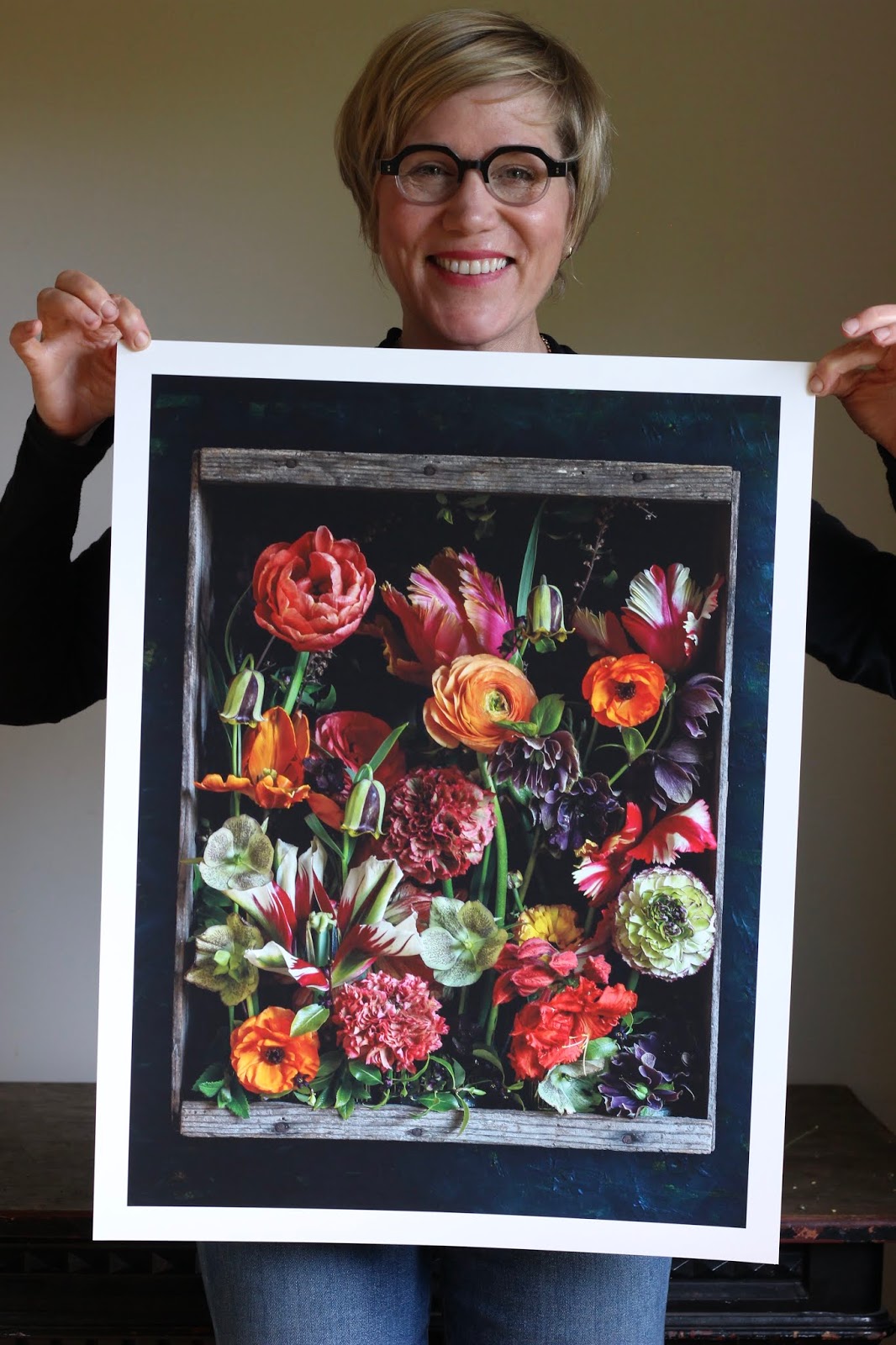
Christin Geall is a Canadian writer, designer, photographer, and author of Cultivated: Elements of Floral Style (Princeton Architectural Press, 2020). Her writing and floral work focuses on the intersections of nature, culture, and horticulture, and she teaches internationally. Trained in horticulture at the Royal Botanic Gardens, Kew, she completed a BA in Environmental Studies & Anthropology and a MFA in Writing (at the Stonecoast Program in Maine, which is where we met), and has been a writing professor and gardening columnist for Gardenista. Architectural Digest called her book “delightfully vibrant” and the Seattle Times recently quipped "Geall might just be the M.F.K. Fisher (American grande dame of food writing) of flowers." 

Please welcome Christin Geall

Flash nonfiction? The segmented memoir? The prose poem? When I was in graduate school studying creative nonfiction, I mastered none of these forms. Despite a background as a lifestyle columnist and editor, I couldn’t write both poetically and short. But I yearned to, so I studied stylists like Abigail Thomas, MFK Fisher, and Annie Dillard.

To get one thing straight right away: I’m a terrible storyteller. And not a great consumer of aural nonfiction stories, either. At dinner parties I’d sooner listen to someone tell a tale as watch them pick their teeth. I like ideas, conversation, and a bit of banter, yes, but I didn’t think myself ironic enough, clever enough, or frankly even online enough, for Twitter. And Facebook, well, I found it either too political or too congenial for decent exchange of thought, much less story.

Enter the image as a writing prompt. A subject for discussion, and suddenly all my storytelling and audience problems were solved. Looking back on how I accumulated 97,000 Instagram followers, and the success of my recent book Cultivated: The Elements of Floral Style (Princeton Architectural Press, 2020), I see now how my training in the micro-essay changed my career as well as my relationship to nonfiction.

I had evolved into a personal essayist, memoirist, and an academic by the time I joined Instagram in 2015, yet I had always struggled to write the longform pieces that my career required. I did possess a deep knowledge and love for plants, so I had thirty years of passion to write about, in addition to a fascination with the ideas and language of the fine arts. Creativity is universal—what I’d learned in grad school about the process of writing, workshopping and critique, I applied to my work with flowers – and then to how I’d tell short stories around them.

On Instagram, where a post is driven by one image, you are limited to 2,200 characters, or roughly about 350 words. Given I’m more sprinter than marathoner, the platform fit. Those 350-ish words, I found, are ample space for a concept to be explained, an idea explored, or even a bit of narration.

As I lobbed ideas to a hash-tagged audience and reflected on their comments, I found my thinking (and opinions) refined. As I encountered friction, or clarification, I entered into conversation. I made friends, of course, learned, networked, and steadily over the past few years, became a sought-after voice in my field.

 When the speaking invitations arrived, I was ready; I built my talks with multiple short “stories” about flowers and the ways they connect us with nature, painting, history, ourselves—just as a good essayist, memoirist, or columnist might do on the page.

By the time the book deal happened—a book combining my photographs with short essays on style, creativity, and everything from Baroque music to wabi sabi to the psychology of colour—I not only had an audience who wanted to learn more, but also 20,000 of the 40,000 words needed for the book.

Photography was not something I’d ever truly wanted to learn, but now that I have, I’m grateful for its silence and the way it pulls me creatively. At first, I had to stretch to create images I thought worthy of an Instagram post, let alone a book, but as I learned to use a camera I found the art itself became another subject for inquiry, which is of course, always a good thing for an essayist. Long or short form.

Note from Lisa: You can connect with Christin at her website, and on Instagram, Facebook, or Twitter. You can find her book, Cultivated, at major online retailers, or order from Indiebound or through your local independent bookstore.


Tuesday, April 7, 2020

Guest Blogger Michelle Cameron on: Launching a Book in the Time of COVID-19: A Personal View

 A little more than seven years ago, I began teaching with The Writers Circle, a regional New Jersey writing community, in large part because of Michelle Cameron, an historical fiction novelist and poet. Since then, we’ve become colleagues in so many ways, and friends.

Please welcome Michelle Cameron, whose newest novel launches today.

I’ve been here before. Sort of.

My first novel, The Fruit of Her Hands, was published by Simon & Schuster’s Pocket Books, during the recession of 2009. My beloved editor was let go three days before my launch, meaning I was then – using the term for authors who experience this phenomenon all too often – orphaned.

No editor means no advocate in the publishing house, so while I had the foresight to hire a publicist who knew the Jewish reading market (my novel was a Jewish historical) and who scheduled many events locally and further afield, I was largely on my own.

The book – a $25 hardcover – was a tough sell. People were hesitant to spend any extra money in a recession, and even those who showed up to events and seemed like the ideal appreciative audience, told me they’d wait for the paperback. But the publisher decided my numbers weren’t strong enough for a paperback.

Fast forward eleven years.

In that time, I’d written three novels. The first, based on the Babylonian Exile, was completed during the long wait for Fruit to be published. I loved the book; I still love the book. My agent did not. After a lukewarm attempt to place it, it went back in my drawer. The second, based on Jewish emancipation during the French Revolution, never really gelled. When I finally, reluctantly, realized the story wasn’t strong enough, I put it aside.

The third novel launches today.                           
                                                          
Beyond the Ghetto Gates, a historical novel set during Napoleon’s first Italian campaign when he liberated the Jews from their restrictive ghettos, had a long slog to publication – an initially enthusiastic agent who tried hard, some nice rejections from publishing houses looking exclusively for the now-pervasive WWII novel. (The trend was for “contemporary historicals,” a phrase that still makes me shake my head in disbelief.)

Finally, I approached the hybrid publisher She Writes Press. And I loved what they did with the book – the beautiful cover, the care and attention to production values. After years of writing, revising, and trying to get published, I wanted to give the novel the best possible chance to find its audience.

From the start, my promotional strategy was to secure synagogue events close to my New Jersey home – hoping that by the time I reached the Jewish Book Council’s presentation to Jewish organizations nationwide, there’d be enough buzz that I’d be one of the lucky authors to be invited to present my novel further afield. (JBC covers airfare and lodging for those authors.)  I hired two publicists – one who worked the media side and a second who by February was doing a brilliant job, booking me for more than two dozen events during April, May, and June.

I was set. I was excited.

Then, COVID-19 struck. And everything unraveled.

Now, I know my problem is tiny in the face of this deadly pandemic. I’m home and my family is healthy. I can continue to teach and work virtually. There’s enough stored food in the house for weeks. I can walk outside without undue fear. I have so much to be thankful for.

Still – this stinks. I’ve postponed or canceled most events. Some may be rescheduled when things return to normal. But I’m not naïve – I know some simply won’t. People move on. Newer books always seem shinier, more appealing.

And I realize this is what publishers have always worried about – sudden catastrophes no one can anticipate or prevent that steal the spotlight from new books. Julia Alvarez’s first novel in 14 years, Afterlife, is pubbing today too. Just imagine how the folks at her publishers, Algonquin, must feel!

But here’s where my bleak story turns positive. Through the generosity of fellow authors and organizations, I’ve pivoted energetically toward social media, accepting offers of video placement, podcasts, blog posts, interviews and live book events on Zoom.

I was featured in a recent virtual reading presented by Murphy Writing of Stockton University and my first chapter will soon be read aloud online (see link below). My publisher is dramatically boosting one book a day for all April releases – my day is April 8. 


The friends I’d tapped for my Street Team are making tremendous efforts on my behalf – re-posting my teaser passages and blurbs, talking up the novel. I’m grateful to them all.

Of course, the essential question remains: will all this virtual activity turn into book sales? For now, I’ve decided only that it certainly can’t hurt. Maybe I’ll reach readers that I never would have before. I truly hope my novel can provide a much-needed escape from this nightmare we’re all living – that my words can touch someone who would never have heard of the book otherwise. May it indeed be so.


Note from Lisa: Connect with Michelle on Facebook, Twitter, and Instagram, and at her website.

You can catch part of Michelle’s Social Media Tour at the following. (More being added daily. See the Events page on her website.)

April 7 – Readers Coffeehouse
April 8 – She Writes Press KEEP CALM AND READ ON Spring Virtual Book Tour with Girly Book Club
April 15, 7:00 pm (Eastern) – She Writes authors Eileen Sanchez and Michelle Cameron in conversation about Beyond the Ghetto Gates via Zoom; click here to register  
April 26 – First Chapter Fun on Hannah Mary McKinnon’s website and on her Instagram Live


Monday, November 19, 2018

Guest Blogger Jane Paffenbarger Butler on: Theme Reading with High School Writers, aka: Pharmacist Dispenses Great Expectations

One of the most enjoyable ways I meet other writers is at small conferences, often over a meal, and one topic that often comes up is how we all make a living while chasing writing goals. That’s how I met Jane Paffenbarger Butler and learned about her unique job—which I’ve invited her to write about here.
Jane has degrees in pharmacy and health systems management and worked in clinical research. While raising three children, she wrote in fits and starts, but then got serious, joining the Brandywine Valley Writers Group and Main Line Writers Group. She’s at work on a memoir, You’ll Get Over It, Jane Ellen. An excerpt placed second in nonfiction at the 2017 Philadelphia Writers Conference. Her work has also appeared in the anthology Unclaimed Baggage, and in the Philadelphia Inquirer. She’s the 2016 and 2014 winner of the West Chester Story Slam.

Please welcome Jane Paffenbarger Butler.

Most days, I adore my job. I am talking about the one where I get to go to my local high school and hang around the English classes talking to kids about their writing. Today, for example, a steady stream of students visited me; some wanted to discuss what to write in their comparative papers on Wuthering Heights and Dante’s Inferno, others needed help proving a point made in Merchant of Venice. It may sound pretty high brow I know, believe me it is not, especially for someone like me who is a pharmacist by training. But the same dynamic occurs whether the students and I are talking about Shakespeare or the Sunday comics. The focus is on art and on the act of responding to it.

Other days, in other classes, I work my way around the room asking each student to tell me their ideas for assigned poetry, memoir, or short story projects. I tell them that ideas mellow and age and do not usually spring to the page fully formed. I tell them that it’s okay, in fact it’s preferable, to get started by just writing in stream of consciousness.

My title is Theme Reader, and I support the work of a high school English teacher by reading and commenting on each student’s writing assignments. Yes, it is a support role, and it is a peach job for someone like me, an aspiring author. This is a teaching job with none of the strings attached. I meet no parents, give no formal grades, and discipline no one. Instead I am a writing coach, and my time is spent reading teenage students’ work and talking to them about the craft of writing.

I am also paid to sit in on the viewing of classic films and TED talks, and get to stay in tune with young people who gladly explain to me such mysteries as gifs and K-pop. And what could be better than sitting in on a discussion of Faulkner’s As I Lay Dying or Twain’s Huck Finn? Or reading twenty-five papers from the AP Literature students who each select, from a lengthy list, a different classic novel to analyze? Often, the students’ detailed breakdown of each book is so complete, by the time I review and offer comments on their projects, it feels as if I’ve just read the book myself.  

Sometimes, in classes where students are not as motivated, it is my duty to inform them of the power of words. That words can be a tool by which we get what we want out of life. I help them see that learning to use words to their advantage could be a way to get out of bad circumstances, a way to rise above people who make life difficult, and a way to work through issues that are hard to manage. Words are power. I love helping them learn how to understand, harness, and wield that power.

In Creative Writing, an elective class, students arrive not as hostages but as volunteers, open to my crazy suggestion that we daydream a little about what it means to be human. With the whole world as fodder for topic, I help students zero in on what their own voice yearns to say. This year I am meeting with an independent study student weekly to work on her novel. The notes I took recently on Robert McKee’s Story, Blake Snyder’s Save the Cat, and Stephen King’s On Writing: A Memoir of the Craft, while trying to elevate my own projects, have become perfect resources for our work together. Sharing such material conveniently reinforces my personal goals, too.

When I was a Clinical Research Monitor at a pharmaceutical company, among my many tasks were study reports and protocols, and I excelled at ensuring the internal consistency between tables and charts and between statistical facts and stated conclusions. I yielded the red pen as editor for a 400-page New Drug Application Summary submitted to the FDA, based on data from hundreds of patients. At my interview for the Theme Reader job, I explained that although I wasn’t a certified teacher and had no degree related to language or English or anything one might suspect relevant (and which the job specs listed), I love teaching and students and the English language. I handed over the bound New Drug Application Summary, the thin manuscript of my memoir, mentioned my membership in local writing groups and my participation in writing conferences. They hired me on the spot. That was ten years ago.

One of Jane's six word memoirs. 
The best part about my job is that I must show up every week and pay attention in class. This time around I am personally interested in what makes for a good story and what constitutes a rhetorical device. My job requires me to say out loud the facts I know to be true about writing, to sit alongside students and reconsider the masters, to teach patience and taking risks on the page, and to learn, learn, learn.

To top it all off, I even get a paycheck.  


Get to know more about Jane at her website and blog.


Monday, June 4, 2018

Guest Blogger Ele Pawelski on the Value of the Ubiquitous Writing Group

Ele Pawelski’s novella, The Finest Supermarket in Kabul, was published by Quattro Books in December 2017. Her short stories have appeared in the Nashwaak Review and Flash Fiction Magazine. A ten-year Toronto resident, this avid adventurer has also lived and managed human rights projects in Afghanistan, South Sudan, Bosnia, Kenya, Uzbekistan, and Kosovo. Ele teaches International Development Law and is writing her next book, a novel featuring parallel stories about a German mother and son trying to find each other after becoming separated during World War II.

Please welcome Ele Pawelski.

I found Moosemeat Writing Group long before I became a fiction author. Thankfully. Otherwise I’d probably still be a struggling memoirist.

In 2010, when I joined Moosemeat, I sought to expand my circle of friends and find a group of like-minded artists willing to help shape my ideas into something readable. The year before, I’d moved to Toronto after working overseas on development projects for twelve years and was still trying to find my footing back at “home.” I liked writing and a few friends suggested I put my experiences of life in post-conflict environments like Afghanistan and Bosnia into a book. I knew how to write academically, but creative writing was a different beast.

So I did what everyone with a problem does: searched online. Moosemeat’s website called out for writers of any ilk. I was in!

Moosemeat’s history goes back to circa 1995, when a group of committed writers wanted to continue meeting up after having taken a writing course together. The name was provoked by an animated debate over a story in which the main character has 10 pounds of moosemeat in a freezer. At least that’s what I’ve heard; Moosemeat membership has completely turned and the originators are long gone. Certainly the moniker gets a laugh, especially when we call ourselves meese or the herd

Eventually, Moosemeat would become the foundation of my writing accomplishments. But first, I had to get up the confidence to submit a story! I remember that meeting very well. I’d submitted a satirical narrative entitled, “Where Taxis Go To Die,” which poked fun at the poor quality of taxis in war-ravaged countries.

Moosemeat’s format is straightforward: in advance of every meeting, two writers submit pieces of less than 6,000 words, either a stand-alone short story or part of something longer. Generally, attendance is between four and fifteen individuals who provide feedback one by one. The writer also has a chance to speak at the end. In addition to regular meetings, once a year, the group collaborates on a chapbook of flash fiction stories and hosts a public reading for contributors. 

I could feel sweat gathering under my armpits. The critiques came fast and furious – it was overly funny, not enough of a story line, too little information about my work colleagues, not enough depth…I got sweatier. When it was my turn to talk, I barely said anything, crushed that my story didn’t seem to work for most members. Upon reflection, the earnestness of the reviewers was obvious; they wanted to help. And a lot of their comments were useful, if only to point me in new directions.

It got easier. Two more similar stories later, I was far less sweaty, and had determined that writing a funny memoir in the style of Bill Bryson was not going to work as I had envisioned. In the process, I read and critiqued a lot of short stories, and listened to the critiques of others. I started to see what worked and what didn’t work on the page. Notably, there isn’t always agreement amongst the meese, which confirms the absolute subjectivity as to how much and why a reader enjoys a certain story.

For example, during a recent critique, half of us thought a short story that ended with no character development was fine as it indicated the protagonist stuck to his guns, while the other half wanted to see some learnings. This kind of diversity signals it is crucial to write to a target audience. But more importantly, it hooked me on the value of other people’s opinions and how those could enrich my own writing.

About a year after being in Moosemeat, I sent out the first chapter of The Finest Supermarket in Kabul. I received an immediate, and very encouraging response via email: “Let me just say “wow!” The verbal feedback at the meeting was also quite positive, but in addition, the previous twelve months had prepped me to take all comments constructively. Over the following three years, I presented the middle and last chapters. Again, the critiques were affirming and helpful, and motivated me to dig deep in terms of a generous re-write when I put the story all together. While I could have submitted the rewritten chapters for further critique – no problems in doing this if a writer chooses – at this point, I felt the story was ready for more directed suggestions.

In exchange for wine, two meese agreed to look over the entire draft novella before I submitted to my publisher and give structural and big picture comments. After I signed on with Quattro Books and incorporated my editor’s suggestions, I convinced one more moose to give me line edits, and check for typos and verb agreement as the story had changed from past tense to present. Without this roster of beta readers, I would have been severely limited as to who I felt comfortable and confident in asking for this kind of help.

Moosemeat has no fees, and membership is fluid, ranging from authors with more than one book under their belt to aspiring novelists to writers who enjoy putting pen to paper but are not looking to publish. The only criteria are the willingness to give honest feedback and periodically submit a story.

Being part of a writing group has spurred my writing to evolve in ways I could not have imagined eight years ago: I’m confident writing in the third person and have tried out the second; I can fashion a decent story arc; I get that a twist at the end doesn’t always make for good reading; and finally, I treat writing more like a job than a hobby. The fact that meese are also excellent cheerleaders means I’m unlikely to drop out anytime soon. We each email the group with any good writing news, attend each other’s writing events, and go out for beers from time to time. What’s more to want from a bunch of random creatives!

Connect with Ele via her website, Twitter, or Facebook. Find Moosemeat here.

Saturday, May 26, 2018

Guest Blogger Debra Borden on Switching from Fiction to Fact

When I began featuring guest bloggers, Debra Borden was one of the first I invited, after meeting at an event for writers in northern New Jersey. In addition to writing, Debra works as a Licensed Clinical Social Worker in New York and New Jersey, helping clients in a variety of settings, including as a “Sous Therapist” in their homes. Cook YourMarriage Happy, the first in her planned Cook Yourself Happy® series, is her third book, following the novels A Little Bit Married and Lucky Me.

Please welcome Debra Borden.

The ultimate moment of joy and validation in my life came on a morning in January 2006. I know this is where I’m supposed to say that was the day I gave birth to my first or second child.  Of course, those were momentous events, but I never felt as validated giving birth as I did getting published. I’m sorry but it’s true.

When the doctor said, ‘you have a little girl’ and three years later, ‘a boy’, I held those babies close and then asked my husband to get me a cheese Danish. When the call came from my agent announcing that my first novel had sold, I sank to my knees and cried. And cried some more. For about an hour.

When the second novel was published, I finally began to believe that I was a writer. And I was sure that fiction was my game. But with the confidence came not more fiction, but instead light-hearted essays --spilling out as if I was born to write humorous truths. In retrospect, the essays weren’t all that different from my novels, which were both told in first person and made liberal use of my personal history—events and feelings, miscues and fantasies. A type of faction.

At the time, I didn’t realize that the essays might also be transitional. But as an LCSW I know something about the word compulsion. I’ve used it to describe clinical features as well as what writing is to me; with a nod to Descartes, I write, therefore I am.

So, it’s not so surprising that I transitioned from fiction to memoir and self-help. I often say that my work as a former school social worker informed my fiction. After all, when doing an evaluation or assessment, I was exploring family dynamics, human development, cultural norms, and home situations: essentially, a job that’s an inadvertent master class in character development and plot. Later, when working with challenging adult clients and I stumbled upon an amazing experiential therapy through cooking, naturally I was compelled to write about it, this time in article, essay, and self-help forms

But when writing novels, I was used to writing in stream-of-consciousness, a method I encourage. My mandate is to get the story down while it’s coming. If I stop too long to edit or correct I fall into the black hole of perfecting the language and I end up with five sentences, all with perfect grammar but no music at all. It seems to me a story or essay is a little word symphony with cadence and melody that needs to be played first. Create now, edit later. 

Except, this often didn’t work for me with nonfiction. Yes, I still wanted it to have a snappy beat and the right key, but for me, nonfiction is more linear, more formatted and defined (sometimes even governed by AP Style). I needed to attend to research, too. And when I began to shape what I had in mind into a book idea, I realized I could best present my material in forms that repeat in some chapters, with similar instructions.

My publisher also was lobbying for some visual and organizational ideas that rankled: boxes and bullet points. Yikes, bullet points? What fresh hell is this?  In keeping with the music metaphor, I was discovering that the kind of book I was attempting was not a medley of hits, but a series of singles. Which is not to say it can’t be entertaining, anecdotal, or creative. I learned to ‘write within the lines’, and I certainly hope every page, chapter, and even bullet point is still delightful.

When I write fiction, I do outline, but it’s loose. I scope out the general arc of the story before I begin with several blank spaces for my characters to weigh in or solutions to unfold. Much of my outline happens in my head when I’m doing other things, like chopping vegetables or not sleeping. But when I tried to write a self-help book in my usual way, I lost structure and forward motion and it caused everyone fits, including me. No sooner would I finish one section and start another that I realized I had to go back and insert or delete from the first.

I was also finding it difficult to bring the uniformity to the chapters that my original publisher envisioned.   While the steps to treating The Stale Marriage and The Sexually-Out-Of-Sync Marriage may be similar, the behaviors they mirror, the recipes I choose, and the reflective processes differ. I’m also a bit creative with fonts and indentations and spacing. And by creative I of course mean incompetent. Six copy editors later (one a famous and expensive New York Times bestselling author) I’ve learned my lesson. And maybe how to write nonfiction in a way that doesn’t require my team to need a sabbatical on a remote island to destress. Yes, I exaggerate.

 Writing Cook Your Marriage Happy, the first in my planned Cook Yourself Happy series was at times frustrating, annoying, daunting and of course, immensely gratifying. I’m so grateful to be able to write and to my readers. But also, to learn. I often say I wrote fictional characters I’d like to emulate, characters that grow and evolve. Going from fiction to fact has also been an evolution for me, although a year ago ‘evolution’ was not the word I would have used. This is why the next volume in the series is called, Cook Your Stressed-Out Self Happy.

Connect with Debra at her website, or email her.


Monday, April 9, 2018

Guest Blogger Rebecca Entel on the Tricks that Helped Her Finish Writing a Full Novel

Rebecca Entel’s first novel is Fingerprints of Previous Owners (Unnamed Press, 2017). Her short stories and essays have appeared in Guernica, Joyland Magazine, Literary Hub, Electric Literature, Cleaver Magazine, The Madison Review, and elsewhere. Rebecca is an Associate Professor at Cornell College, where she teaches multicultural American literature, Caribbean literature, creative writing, and the literature of social justice. She holds a Ph.D. in English from the University of Wisconsin and a BA in English from the University of Pennsylvania. Rebecca grew up in Cleveland and currently lives in Iowa City.

Please welcome Rebecca Entel.

Maybe it’s part of my process to imagine having better writing days than I actually have. In my mind’s eye, there I am at my desk or on the couch or at a table in the library, fingers flying as I produce and produce and produce. It’s much harder to be inside that body I’m imagining watching from afar – to be the one staring at the screen, resisting the click-away temptation of the internet, believing in what could come next.

I had been writing and teaching writing for many years before publishing Fingerprints of Previous Owners. Part of my process in writing that first novel was seeing if I could, in fact, even finish one. I got to travel many times for this project, which takes place at a Caribbean resort built over the ruins of a slave plantation. I even learned how to use a machete to reach those ruins for my research. But most of my time was spent staring at the screen, feeling frustrated. I’d spend too much time trying to get the conditions right for becoming the writer that existed in my mind, and then when I actually sat down to write, I’d feel fundamentally not up to the task. Those images of watching myself writing prolifically had become one more weight getting in my way.

The only way I seemed to get anything done was when I tricked myself into writing, by using all the tricks I’d counseled my students to use when they were feeling stuck. Two of these tricks had a major impact on the development of the book.

What’s something you know about that your readers may not?

A grad professor of mine once recommended we think about this question, finding something unique to describe that might inject some energy. Posing it to myself, I thought back to learning how to use that machete. I’d been taught it was a tool of gravity, not of force. No matter how strong you were, hacking away wouldn’t do much good. You need a sharp blade and the right angle, then let gravity do its job. I began free-writing about this and discovered a voice that belonged to Myrna, the book’s main character, who was secretly excavating the ruins. The machete became thematically important, too, since Myrna didn’t have much power, physical or otherwise; she had to be sharp and find the right angle to get where she wanted to go.

What will you learn if you free-write from a minor character’s perspective?

I advise my students to find multiple ways to jump away from the main thrust of their stories. This particular exercise isn’t necessarily about writing material to be included in the text; it’s about the writer discovering new information.

On the days I felt most stuck, I let myself write short narratives from the perspectives of minor characters in my protagonist’s community. I learned a ton about the island’s history, more than my narrator could know, and much of it allowed me to add texture to the fictional island I was creating, where what does not get talked about fuels Myrna’s machete adventures. That secretive aspect of the book hedged me in because I couldn’t reveal anything beyond Myrna’s perspective, which, combined with the typical limitation of the first-person narrator, and her intense focus on her excavations, isolated her character from friends and family.

Some of these free-writing exercises eventually became parts of the book in which I let other characters speak. These characters never would have come to life if I hadn’t let myself experiment with their voices. In talking to readers, I’ve learned how important these side stories were to their reading experience. They needed these breaks from Myrna’s perspective. So perhaps my feelings of being mired in the writing was actually a clue into what my readers might feel, too.

I wouldn’t have finished Fingerprints if I hadn’t relied on these tricks to help me stop thinking about the to-be-finished Fingerprints. I hadn’t thought of the various exercises I offer students as necessarily related before, but I came to see that many of them focused on relieving writers of the pressure of writing a book –  distracting writers from that larger aim so they could write something.

In speaking with other writers, particularly students, I’ve also been reminded how helpful it is to hear writers speak honestly and practically about what their processes were before their books were ever books.

Connect with Rebecca at her website, on Twitter, Facebook, and Instagram.

She is teaching an online novel writing workshop for Catapult beginning in June.

Wednesday, February 7, 2018

Guest Blogger, Novelist Anca L. Szilágyi on Whatever Works: Looking at Visual Art to Write Inspired Prose

 I guess in the past debut authors talked in person about the trajectory hurling them toward launch day—and the rolling emotions and endless details that accompany that journey. Today, we find one another in specialized Facebook groups and exchange intel. That’s how I got to know Anca Szilágyi.

Anca is the author of the newly published novel, Daughters of the Air, which Shelf Awareness called “a striking debut from a writer to watch.” Her writing appears in Salon, Los Angeles Review of Books, and Lilith Magazine, and she will be teaching Writing Contemporary Fairy Tales at Portland (Oregon’s) Literary Arts and with StoryStudio Chicago while on book tour. She received the inaugural Artist Trust/Gar LaSalle Storyteller Award, and earned grants and fellowships from Vermont Studio Center, 4Culture, Made at Hugo House, and the Jack Straw Cultural Center. Originally from Brooklyn, she currently lives in Seattle.

Please welcome Anca L. Szilágyi.

            When I was just starting to write seriously, I fetishized notebooks—and, like an eight-year-old—stickers.  I preferred black, hard-backed notebooks with graph paper that forced my writing into small, neat boxes.  My favorite treat was popping into a stationary store in Cobble Hill, Brooklyn, to buy a cheap book of Dover Art Stickers depicting famous paintings by Michelangelo, Kahlo, Goya, and the like. I was trying to write the first draft of my first novel, Daughters of the Air, using Hemingway’s supposed model of 300 words a day, no more, no less, stopping mid-sentence and all that jazz. The mid-sentence idea was cool; there’s always something to come back to. (And if you didn’t remember what you were coming back to, maybe it wasn’t all that good to begin with.)

            Aside from the word count, I didn’t have a very language-oriented approach to writing, which, come to think of it, is kind of strange. I don’t like complicated writing prompts. (Write a dialogue between a mother and a cat. The mother should be in a sour mood saying sweet things, and the cat should be doing something that is both like and unlike a cat. Include the words mousse, temperament, and proclivity.)  In addition, the blank page was your typical blank-page nightmare, even with all those calming blue gridlines. So, in came the art. I would shuffle the stack of sticker books with my eyes closed, randomly open one and choose a sticker. Then came joy, disappointment, or bafflement at my selection. The tiny reproduction took up a square of space on the page, and then I had to write. Whatever came to mind. Hopefully related to the book. Sometimes not.

            The really famous painters oozed their egos all over the page. I had little to say about Michelangelo. Kahlo demanded I only write about Kahlo. Which is fine, because I love Kahlo, but my novel has nothing to do with her. It was the lesser known painters, to me at least, that gave me an opening. Sad, dark flowers by Nolde. Chagall’s gold-hued and green warmth. Modigliani’s eyeless women. Kandinsky’s colorful abstractions, suggesting messy, unarticulated internal conflicts.

            Over time, Nolde faded away, but Chagall fueled the father in my novel, Modigliani the mother, and Kandinsky their daughter, Pluta. Through all this groping in the dark with my shuffling, I learned to return to these three artists in particular. (Goya dropped in sometimes.)  In retrospect, I can see how these painters shaped the novel’s characters in personality and to some lesser extent, their biographies.

The father in my novel is warm and is an Ashkenazi Jew. Modigliani didn’t paint eyes as he felt they were too intimate, and the mother in my novel is cold and distant. And, like Modigliani, a Sephardic Jew. (These two demographic tidbits also aligned with the Jewish cultures of Buenos Aires I had been researching.)  Writing from Kandinsky’s works was a special challenge (no gestures, no objects), but somehow, they suggested a path for my protagonist, Pluta, in her emotional and actual journey: messy, indirect, all scribbled up.

            When I finished the first draft, this ekphrastic process gradually fell away. The raw material was before me, and it was time to make sense of it. A couple of reviews have called my book surprising (in a good way, thank goodness), and I think in part the surprising quality came from the experiment of engaging with art in this way.

It was hardly the most efficient way of writing a novel. That first draft took several years, and then I went to graduate school and rewrote the book. But I’m not sure efficiency is something we should necessarily value in art. It’s art, after all—not paint-by-numbers. Even as it is painful to grope around in the dark looking for the shape of a story and its meaning, even as it could take longer—much longer—than you would expect—if it wasn’t a surprising process with surprising results why would I even write?


You can find Anca at her website or on Twitter. Her book tour is taking her to Bainbridge Island, Spokane, Portland, Boston, New York, Chicago, and Tampa (for AWP) this winter, with additional spring and summer West Coast events, all listed here.