Showing posts with label segmented form. Show all posts

Tuesday, May 26, 2020

Guest Blogger Christin Geall on Insta-prose: Developing an Audience Through Images

Christin Geall is a Canadian writer, designer, photographer, and author of Cultivated: Elements of Floral Style (Princeton Architectural Press, 2020). Her writing and floral work focuses on the intersections of nature, culture, and horticulture, and she teaches internationally. Trained in horticulture at the Royal Botanic Gardens, Kew, she completed a BA in Environmental Studies & Anthropology and a MFA in Writing (at the Stonecoast Program in Maine, which is where we met), and has been a writing professor and gardening columnist for Gardenista. Architectural Digest called her book “delightfully vibrant” and the Seattle Times recently quipped "Geall might just be the M.F.K. Fisher (American grande dame of food writing) of flowers." 

Please welcome Christin Geall

Flash nonfiction? The segmented memoir? The prose poem? When I was in graduate school studying creative nonfiction, I mastered none of these forms. Despite a background as a lifestyle columnist and editor, I couldn’t write both poetically and short. But I yearned to, so I studied stylists like Abigail Thomas, MFK Fisher, and Annie Dillard.

To get one thing straight right away: I’m a terrible storyteller. And not a great consumer of aural nonfiction stories, either. At dinner parties I’d sooner listen to someone tell a tale as watch them pick their teeth. I like ideas, conversation, and a bit of banter, yes, but I didn’t think myself ironic enough, clever enough, or frankly even online enough, for Twitter. And Facebook, well, I found it either too political or too congenial for decent exchange of thought, much less story.

Enter the image as a writing prompt. A subject for discussion, and suddenly all my storytelling and audience problems were solved. Looking back on how I accumulated 97,000 Instagram followers, and the success of my recent book Cultivated: The Elements of Floral Style (Princeton Architectural Press, 2020), I see now how my training in the micro-essay changed my career as well as my relationship to nonfiction.

I had evolved into a personal essayist, memoirist, and an academic by the time I joined Instagram in 2015, yet I had always struggled to write the longform pieces that my career required. I did possess a deep knowledge and love for plants, so I had thirty years of passion to write about, in addition to a fascination with the ideas and language of the fine arts. Creativity is universal—what I’d learned in grad school about the process of writing, workshopping and critique, I applied to my work with flowers – and then to how I’d tell short stories around them.

On Instagram, where a post is driven by one image, you are limited to 2,200 characters, or roughly about 350 words. Given I’m more sprinter than marathoner, the platform fit. Those 350-ish words, I found, are ample space for a concept to be explained, an idea explored, or even a bit of narration.

As I lobbed ideas to a hash-tagged audience and reflected on their comments, I found my thinking (and opinions) refined. As I encountered friction, or clarification, I entered into conversation. I made friends, of course, learned, networked, and steadily over the past few years, became a sought-after voice in my field.
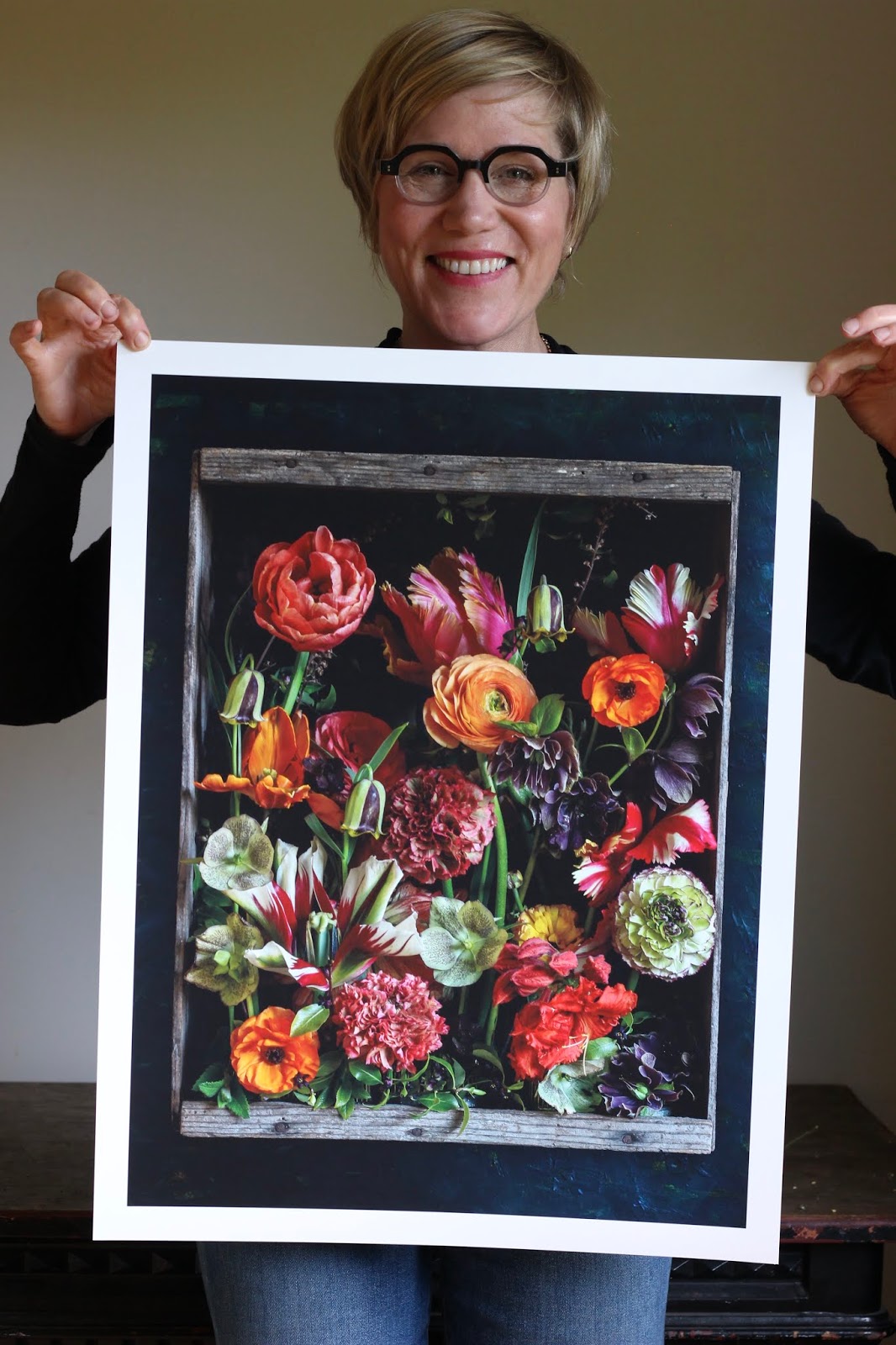
 When the speaking invitations arrived, I was ready; I built my talks with multiple short “stories” about flowers and the ways they connect us with nature, painting, history, ourselves—just as a good essayist, memoirist, or columnist might do on the page.

By the time the book deal happened—a book combining my photographs with short essays on style, creativity, and everything from Baroque music to wabi sabi to the psychology of colour—I not only had an audience who wanted to learn more, but also 20,000 of the 40,000 words needed for the book.

Photography was not something I’d ever truly wanted to learn, but now that I have, I’m grateful for its silence and the way it pulls me creatively. At first, I had to stretch to create images I thought worthy of an Instagram post, let alone a book, but as I learned to use a camera I found the art itself became another subject for inquiry, which is of course, always a good thing for an essayist. Long or short form.

Note from Lisa: You can connect with Christin at her website, and on Instagram, Facebook, or Twitter. You can find her book, Cultivated, at major online retailers, or order from Indiebound or through your local independent bookstore.


Monday, August 24, 2015

Reading in Small Chunks, Taking in Big Wisdom from Abigail Thomas's New Memoir

I've been a fan of Abigail Thomas since I first read her memoir A Three Dog Life (2006), and then immediately looked back and read her previous memoir, Safekeeping, which broke so many memoir writing "rules" when it first appeared in 2000.

I also appreciate what Thomas puts up on her website as craft advice and writing exercises that have helped many creative nonfiction writers. I've sent a bunch of students over there, and the result is always that they come back to me with some version of, "I tried X, and wrote something I never thought about before…" usually followed by some excited version of what they plan to do with their new material, and newly acquired skill or craft idea.

I dove into her newest memoir, What Comes Next and How to Like it (2015) months ago, then it was lost (along with a few other just-started-reading books) to the clutter of my office, and when it resurfaced a few weeks ago, I brought  it to the beach. That was the perfect environment for a book in segmented form; some chapters were no more than a single sentence, others ran for a handful of pages. I typically love such quilted work.

But selfishly, I found myself wishing this time to have not quite so many stops and starts. Thomas is able to build such depth and momentum in each richly constructed short section that I simply craved for each one to keep going, on and on. Though when I considered that so many of the mini-chapters could have been entire books in themselves, I realized perhaps that only further cemented Thomas's wisdom and skill in terms of structure, organization, and presentation. What's left out matters so much. Leave the readers wanting more, always!

Most of the time when I read, I have nearby a pad of tiny sticky page markers. I use them to bookmark lines I keep returning to, passages I want to read again and again to try to figure out the writer's craft decisions, or just places where the prose sounds lovely or says something interesting which I want to share with someone, sometime.

Here are a few:

In "Bad Memory," when writing about growing older and gaining weight: "…it looks as if I have an open umbrella concealed under my skirt. How did that happen? I think, oh well, I was young once and slender and pretty and I made the most of it. It's somebody else's turn now."

(I might simply say, "Ditto" but that would make me look old.)

In "Sleeping With Dogs," on why, at approaching 70ish, she prefers being single, and the company of dogs: "Lots of people on my somewhat leaky boat are on the lookout for a human companion. Not me. I have learned to love the inside of my own head. There isn't much I'd rather say then think."

(No dogs for me, and I love the clatter of family, but when they're all away for hours or a day—I quickly retreat to that place in my head where I can think and not talk.)

In "Mindfulness," Thomas notices the gift of a broken dishwasher: "…there are always dishes in the sink anyway, and now I am going to wash them as they appear. It is a contemplative activity. Here is the Fire King golden cup from the set my daughter Jennifer gave me. Here is the big mug my daughter Catherine uses for her tea when she drops by. Here is last night's cast-iron pan with the remnants of a roast chicken…."

This last hit me personally because our dishwasher was declared too expensive to fix last October, and we've all—me, husband, both sons—have been washing dishes ever since, and though we each mildly complain about it, I've noticed similar advantages. Sometimes it keeps more than one us in the kitchen longer after a meal, talking, joking. One son says it's very calming, he likes the sounds of the water. The other plugs in his iPod and nods and sings along and shuffles a little dance at the sink. When alone, I wash slowly, steal glimpses straight ahead out through the back window, and think. Or write in my head too. Or go over beautifully crafted writing I've recently read. Which is what I did yesterday, and why I am writing about Abigail Thomas today.

p.s. If you are a visual artist as well as a writer/reader, you're really going to like What Comes Next, which also offers thoughts, misgivings, excitement, and pleasure about the author's forays into painting.

Images:  Washing dishes - Flickr/Creative Commons - Jenny Downing